




















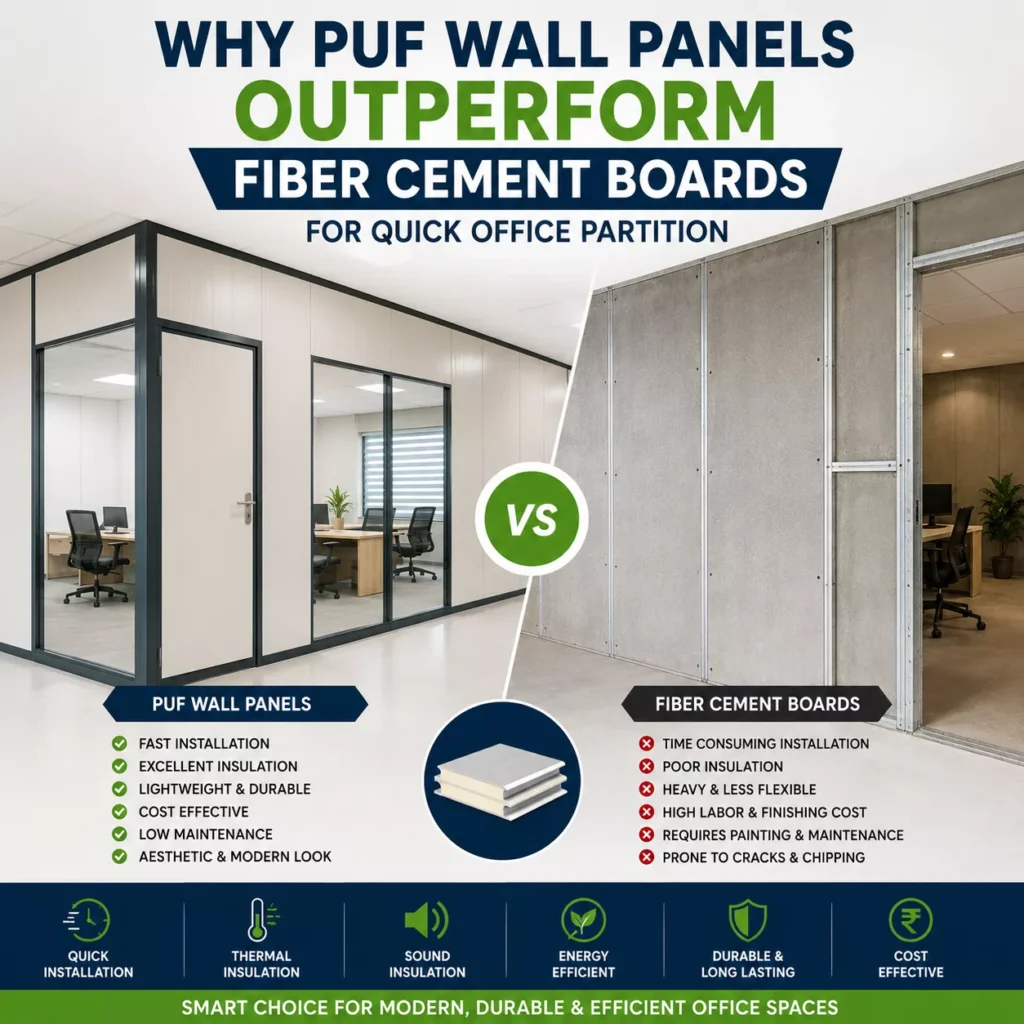
Modern businesses require office spaces that can be built quickly, efficiently, and with minimal disruption to daily operations. Whether it is a new corporate office, a factory administration block, a site office, or an industrial workspace, companies increasingly prefer modular partition systems over conventional construction methods. Among the most popular partition materials are PUF wall panels and fiber cement boards. While both serve as partitioning solutions, PUF wall panels offer significant advantages in terms of installation speed, insulation, durability, and long-term value.
If you are planning a modern office partition, understanding the differences between these two materials can help you make a cost-effective and future-ready investment.
What Are PUF Wall Panels?
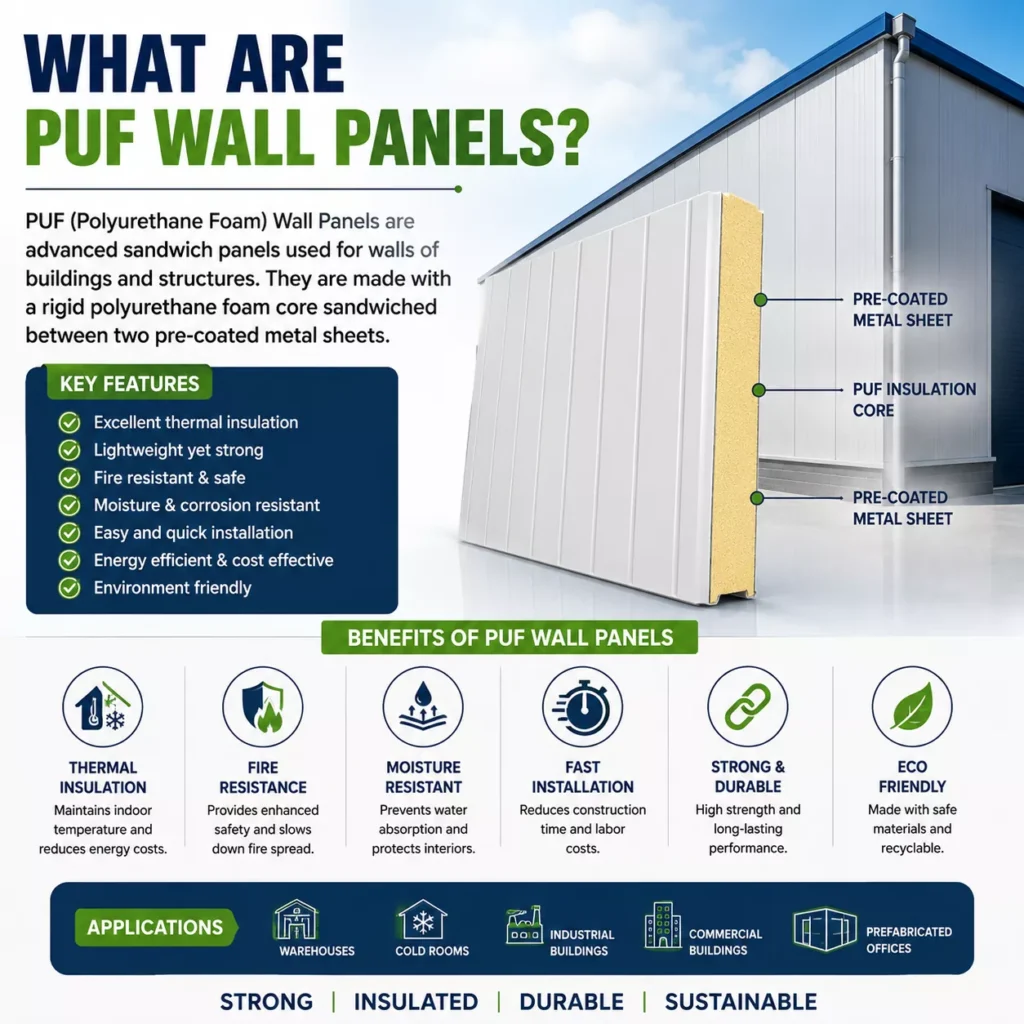
PUF (Polyurethane Foam) wall panels are insulated sandwich panels manufactured by bonding a rigid polyurethane foam core between two pre-coated metal sheets. This construction creates a lightweight yet highly durable panel that provides excellent thermal insulation, sound reduction, and structural strength.
PUF wall panels are widely used in:
- Office partitions
- Prefabricated offices
- Industrial buildings
- Clean rooms
- Cold storage facilities
- Commercial buildings
- Healthcare facilities
- Educational institutions
Their modular design allows them to be installed quickly while delivering a clean and professional finish.
What Are Fiber Cement Boards?
Fiber cement boards are made from cement reinforced with cellulose fibers and other additives. They are commonly used for walls, ceilings, and partitions because of their rigidity and fire-resistant properties.
Although fiber cement boards have been used in construction for many years, they generally require additional framing, insulation materials, finishing work, and painting before they become suitable for office interiors.
As businesses increasingly seek faster and more energy-efficient construction methods, many are switching to insulated PUF wall panels.
Faster Installation Saves Time
One of the biggest advantages of PUF wall panels is their rapid installation.
Since these panels are factory-manufactured with finished surfaces, they arrive ready for installation. The interlocking panel system allows installers to assemble office partitions quickly without extensive masonry or wet construction.
Fiber cement boards require several additional steps, including:
- Steel or wooden framework installation
- Board fixing
- Joint treatment
- Surface finishing
- Putty application
- Painting
- Drying time
These extra processes increase project duration significantly.
In contrast, PUF wall panels reduce installation time dramatically, enabling businesses to occupy their offices sooner and minimizing operational downtime.
Superior Thermal Insulation
Office comfort plays an important role in employee productivity. PUF wall panels contain a high-density polyurethane insulation core that effectively reduces heat transfer.
This insulation helps maintain comfortable indoor temperatures throughout the year while reducing the load on air conditioning systems.
Fiber cement boards have very limited insulation properties. To achieve similar thermal performance, additional insulation materials must be installed separately, increasing both project cost and construction complexity.
With PUF wall panels, insulation is already integrated into the panel itself.
Better Energy Efficiency
Energy-efficient buildings are becoming increasingly important for organizations aiming to reduce operating costs and environmental impact.
The insulated core of PUF wall panels minimizes heat gain during summer and heat loss during winter. This reduces energy consumption by HVAC systems and contributes to lower electricity bills.
Fiber cement board partitions alone cannot provide the same level of thermal efficiency, making them less effective in energy-conscious office environments.
Excellent Sound Insulation
Modern offices require quiet working environments to improve employee concentration and communication.
PUF wall panels offer superior acoustic insulation by reducing sound transmission between rooms and departments. Meeting rooms, conference halls, executive cabins, and workstations benefit from enhanced privacy and reduced noise.
Fiber cement boards provide only basic sound resistance unless additional acoustic insulation materials are installed.
Choosing insulated wall panels helps create a more productive workplace without adding extra construction layers.
Lightweight Construction
PUF wall panels are significantly lighter than conventional partition systems.
Their lightweight construction offers several advantages:
- Easier transportation
- Faster handling
- Reduced structural load
- Lower foundation stress
- Simplified installation
This makes them particularly suitable for factory offices, mezzanine floors, temporary office spaces, and modular commercial buildings.
Although fiber cement boards are lighter than masonry walls, they remain considerably heavier than insulated sandwich panels.
Attractive Factory-Finished Appearance
Modern office interiors demand clean, professional aesthetics.
PUF wall panels feature smooth, factory-finished surfaces available in various colors and finishes. Since the panels are pre-finished, no plastering or painting is required after installation.
Fiber cement boards generally require surface preparation, putty, primer, and paint before achieving an attractive appearance. Over time, painted surfaces may require maintenance and repainting.
The ready-to-install finish of PUF panels reduces both construction time and maintenance costs.
Moisture and Water Resistance
Office environments often experience humidity fluctuations, especially in industrial locations.
High-quality PUF wall panels resist moisture penetration and help prevent condensation, mold growth, and wall deterioration. Their metal surfaces also protect against water damage when installed correctly.
Fiber cement boards can absorb moisture over time if not properly sealed, potentially leading to staining, deterioration, or maintenance issues.
For areas with high humidity, insulated PUF panels provide a more durable solution.
Low Maintenance Requirements
Maintenance costs directly influence the long-term value of office interiors.
PUF wall panels require minimal maintenance due to their corrosion-resistant metal surfaces and durable insulation core. Routine cleaning is generally sufficient to maintain their appearance.
Fiber cement boards may develop surface cracks, paint peeling, or joint issues over time, requiring periodic repairs and repainting.
Businesses looking for low-maintenance office solutions often find PUF wall panels to be a more economical choice over the building’s lifespan.
Durability for Long-Term Performance
Office partitions should withstand daily wear and tear without losing their structural integrity.
PUF wall panels are engineered for long-lasting performance and resist impact, corrosion, temperature fluctuations, and environmental exposure.
Their insulated construction maintains strength while providing reliable performance for years.
Fiber cement boards are durable but are more susceptible to edge damage, cracking during handling, and surface maintenance requirements.
Flexible and Modular Design
Business requirements change frequently. Companies may need to expand, relocate, or redesign office layouts.
PUF wall panels support modular construction, allowing partitions to be dismantled, relocated, or extended with relative ease.
This flexibility makes them ideal for:
- Industrial offices
- Temporary project offices
- Site offices
- Startup workspaces
- Commercial buildings
- Factory administration blocks
Fiber cement board partitions are more permanent and typically require demolition for layout modifications.
Improved Hygiene
Clean office environments are especially important in pharmaceutical, food processing, healthcare, and laboratory facilities.
The smooth metal surfaces of PUF wall panels are easy to clean and disinfect. Their non-porous finish helps maintain hygienic conditions while reducing dust accumulation.
Fiber cement boards have textured surfaces that may require additional finishing to achieve similar cleanliness standards.
Cost Benefits Over the Project Lifecycle
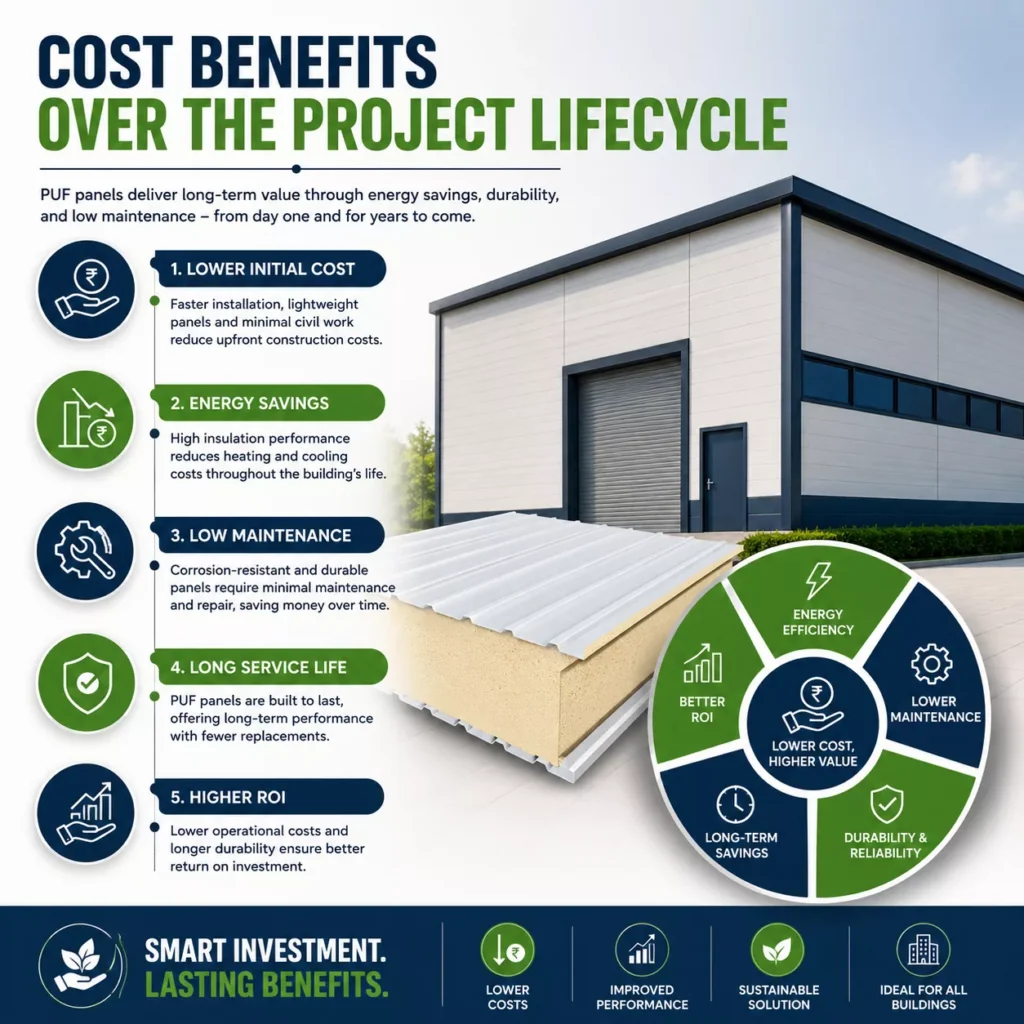
While initial material costs vary depending on specifications, evaluating the complete project cost provides a better comparison.
PUF wall panels reduce expenses through:
- Faster installation
- Lower labor costs
- No plastering
- No painting
- Built-in insulation
- Reduced HVAC energy consumption
- Minimal maintenance
- Faster project completion
Fiber cement board systems often involve additional costs for framing, insulation, finishing, painting, and future maintenance.
Considering both installation and operational expenses, PUF wall panels frequently offer greater long-term value.
Applications of PUF Wall Panels
PUF wall panels are suitable for numerous office environments, including:
- Corporate offices
- Industrial administration buildings
- Manufacturing facilities
- IT offices
- Educational institutions
- Healthcare facilities
- Clean rooms
- Commercial complexes
- Prefabricated offices
- Warehouses with office cabins
Their versatility makes them an ideal partition solution across multiple industries.
Environmental Benefits
Sustainable construction has become a priority for modern organizations.
PUF wall panels support environmentally responsible building practices by:
- Improving energy efficiency
- Reducing construction waste
- Lowering carbon emissions through reduced energy use
- Supporting modular and reusable construction
- Extending building lifespan
These benefits contribute to greener commercial buildings and help organizations meet sustainability goals.
Conclusion
When comparing PUF wall panels vs fiber cement boards for office partitions, PUF wall panels clearly deliver superior performance in terms of speed, insulation, energy efficiency, durability, and long-term cost savings. Their factory-finished surfaces, lightweight construction, excellent thermal and acoustic insulation, and modular installation make them an ideal solution for businesses seeking modern office spaces without lengthy construction delays.
Whether you are building a new corporate office, expanding an industrial workspace, or creating temporary office cabins, PUF wall panels provide a reliable, efficient, and future-ready partition solution. By choosing insulated PUF wall panels over conventional fiber cement boards, businesses can achieve faster project completion, improved workplace comfort, reduced maintenance, and greater operational efficiency for years to come.
Frequently Asked Questions
PUF wall panels are insulated sandwich panels consisting of a rigid polyurethane foam (PUF) core bonded between two metal sheets. They are widely used in industrial buildings, cold storage, clean rooms, warehouses, and prefabricated structures due to their excellent insulation and structural strength.
Fiber cement boards are building boards made from cement reinforced with cellulose fibers. They are commonly used for wall cladding, partitions, ceilings, and exterior applications where durability is required.
PUF wall panels offer superior thermal insulation, faster installation, lighter weight, better energy efficiency, and lower maintenance requirements compared to conventional fiber cement boards.
PUF wall panels provide significantly better thermal insulation because of their polyurethane foam core, which minimizes heat transfer and helps maintain comfortable indoor temperatures.
PUF wall panels are prefabricated and designed with interlocking joints, allowing much faster installation than fiber cement boards and reducing overall construction time.
Yes. Viraat Industries offers PUF wall panels in multiple thickness options, including 30 mm, 50 mm, 80 mm, 100 mm, and 120 mm, to meet different insulation and structural requirements.