























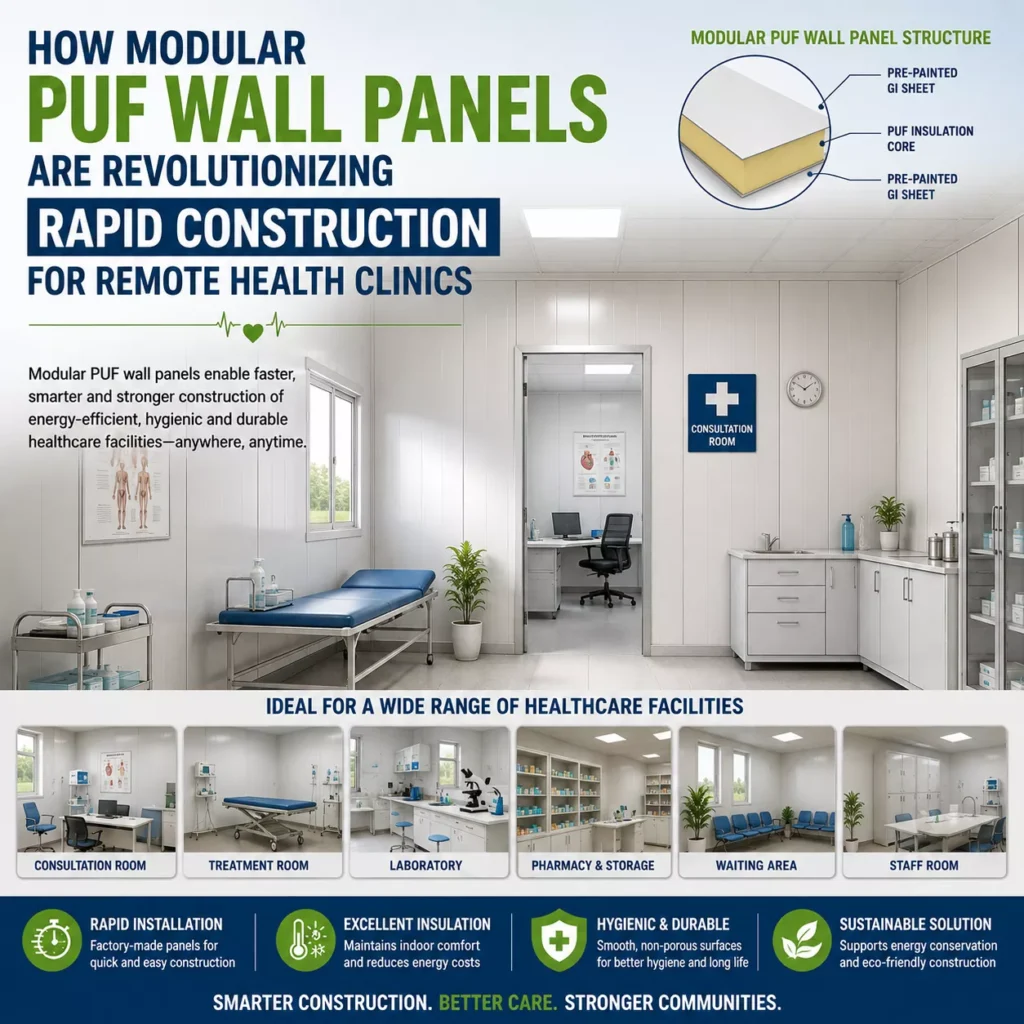
Healthcare providers often need to establish facilities quickly and efficiently in remote and underserved areas while minimizing disruption. Traditional construction methods often require lengthy timelines, extensive labor, complex transportation, and large quantities of materials. These challenges can make it difficult for healthcare organizations to establish facilities in areas that need them most.
Modular PUF wall panels are changing this approach by offering a practical solution for rapidly constructed healthcare infrastructure. Designed with an insulated polyurethane foam core between protective metal sheets, PUF panels provide thermal insulation, structural performance, durability, and faster installation. Healthcare providers can use modular PUF wall panels to create medical rooms, consultation areas, laboratories, pharmacies, waiting areas, temporary healthcare facilities, and modular clinics.
Remote health clinics often have limited construction resources, so modular PUF wall panels offer a practical combination of fast installation, thermal insulation, flexibility, and easy maintenance.
Why Remote Healthcare Construction Needs a Faster Solution
Remote healthcare projects often face unique construction challenges. Sites may be located far from cities, making transportation of conventional construction materials and skilled labor more complicated.
Projects may also experience:
- Limited access to construction resources
- Difficult transportation conditions
- Short construction schedules
- Extreme weather conditions
- Higher labor requirements
- Limited availability of skilled workers
- Increasing material costs
A modular construction approach helps overcome many of these challenges. Teams can transport factory-manufactured PUF panels to the project site and assemble them quickly, reducing the need for conventional construction work.
What Are Modular PUF Wall Panels?
Modular PUF wall panels feature a rigid Polyurethane Foam (PUF) core between two metal sheets. Manufacturers produce these insulated panels under controlled conditions to maintain consistent dimensions, insulation performance, and surface quality.
Unlike conventional brick or block walls that require multiple construction stages, manufacturers supply PUF wall panels as ready-to-install components.
This allows contractors to create enclosed spaces much faster while reducing wet construction activities at the project site.
Faster Construction for Remote Clinics
One of the most important advantages of modular PUF wall panels is their installation speed.
Traditional walls may require masonry work, cement, plastering, curing, painting, and finishing. Each stage adds time to the project.
PUF panels simplify construction by providing factory-finished wall sections that installation teams can quickly fix to suitable framing systems using appropriate fasteners.
For remote health clinics, faster installation can mean:
- Earlier completion of the facility
- Reduced site labor
- Less construction waste
- Lower transportation requirements
- Reduced project disruption
- Faster availability of healthcare services
This makes modular panels particularly valuable for emergency healthcare facilities and projects operating under strict deadlines.
Excellent Thermal Insulation
Remote clinics may operate in locations with very hot, cold, or fluctuating temperatures. Maintaining a comfortable indoor environment is important for healthcare workers, patients, medicines, and medical equipment.
The PUF core provides effective thermal insulation by reducing heat transfer through the walls.
This can help:
- Maintain more stable indoor temperatures
- Reduce cooling requirements
- Improve patient comfort
- Reduce the workload on air-conditioning systems
- Support energy-efficient clinic operation
For healthcare facilities located in regions with high temperatures, insulated wall panels can be an important part of the building envelope.
Energy-Efficient Healthcare Infrastructure
Healthcare facilities may require continuous cooling, lighting, ventilation, refrigeration, and medical equipment. Electricity availability can also be a challenge in remote areas.
Improved insulation helps reduce unnecessary heat gain and heat loss, potentially lowering the energy demand associated with maintaining indoor conditions.
When combined with energy-efficient HVAC systems, lighting, and other building technologies, modular PUF wall panels can contribute to a more energy-efficient healthcare facility.
This is especially beneficial for clinics using solar power, battery storage, generators, or other limited energy sources.
Hygienic and Easy-to-Maintain Surfaces
Hygiene is an important consideration in healthcare construction. Walls should be easy to clean and maintain while supporting a controlled indoor environment.
PUF wall panels provide smooth factory-finished surfaces that can be easier to clean than unfinished conventional wall systems.
They can be used in areas such as:
- Consultation rooms
- Treatment rooms
- Laboratories
- Pharmacies
- Medical storage areas
- Reception spaces
- Staff rooms
- Waiting areas
For applications requiring higher hygiene standards, appropriate panel specifications, joints, sealants, and finishing systems should be selected according to the project’s requirements.
Lightweight Construction for Difficult Locations
Remote construction sites may have transportation and access limitations. Heavy conventional building materials can increase logistical challenges.
Modular PUF panels are relatively lightweight compared with many conventional wall construction systems. Their manageable weight can make transportation and installation more convenient.
This is particularly useful for:
- Rural healthcare centers
- Mountainous locations
- Temporary medical camps
- Disaster-response clinics
- Construction sites with limited road access
- Mobile healthcare facilities
The panels can be delivered to the location and assembled using a planned installation process.
Reduced Construction Waste
Traditional construction can generate significant amounts of waste from bricks, mortar, cement, plaster, packaging, and finishing materials.
Manufacturers produce prefabricated PUF panels according to predetermined dimensions, which helps improve material utilization.
Reduced site waste can provide several benefits:
- Cleaner construction sites
- Easier waste management
- Reduced material handling
- Faster project completion
- More organized installation
For remote locations where waste disposal facilities may be limited, minimizing construction waste can be particularly advantageous.
Flexible Clinic Design
Healthcare requirements can change over time. A small clinic may eventually require additional consultation rooms, storage areas, staff accommodation, or treatment spaces.
Modular construction allows greater flexibility than many permanent conventional structures.
PUF wall panel systems can be incorporated into modular layouts for:
- Small rural clinics
- Primary healthcare centers
- Temporary medical facilities
- Diagnostic centers
- Vaccination centers
- Emergency treatment units
- Mobile healthcare infrastructure
The ability to customize dimensions and internal layouts makes modular construction suitable for different healthcare applications.
Suitable for Prefabricated Healthcare Buildings
PUF wall panels are particularly effective when combined with prefabricated building systems.
A complete modular healthcare facility can incorporate insulated wall panels, roof panels, doors, windows, electrical systems, flooring, and other components into an integrated structure.
This approach can significantly reduce on-site construction activities.
Prefabricated clinics can be designed according to the project’s size, location, functional requirements, and expected occupancy.
Weather Resistance and Durability
Remote clinics need building materials capable of handling local environmental conditions. Rain, sunlight, humidity, wind, and temperature changes can affect building performance.
Quality PUF sandwich panels with suitable exterior coatings and properly designed joints can provide reliable protection against common environmental conditions.
Proper installation is essential to achieve the expected performance of the complete wall system. Panel joints, fasteners, flashing, sealants, and drainage details should be installed according to the project’s technical requirements.
Cost-Effective Construction
Cost is a major consideration when developing healthcare infrastructure, particularly when projects are funded with limited budgets.
Modular PUF wall panels can help control costs through:
- Faster installation
- Lower site labor requirements
- Reduced construction waste
- Lower finishing requirements
- Reduced project duration
- Improved thermal efficiency
The total project cost depends on panel specifications, structural requirements, transportation, installation, site conditions, and building services. However, modular construction can provide significant advantages when both initial construction and long-term operating costs are considered.
Applications of PUF Panels in Healthcare
Modular PUF wall panels can support a wide range of healthcare infrastructure requirements.
Common applications include:
Rural Health Clinics:
Rapidly constructed facilities for communities located away from major cities.
Emergency Medical Centers:
Temporary or semi-permanent healthcare structures that need to become operational quickly.
Diagnostic Centers:
Modular spaces for testing, consultation, and diagnostic services.
Pharmacies and Medical Storage:
Insulated spaces for storing healthcare products where controlled temperatures may be required.
Vaccination Centers:
Quickly deployable spaces for organized vaccination programs.
Staff Accommodation:
Comfortable insulated rooms for doctors, nurses, technicians, and support staff.
Mobile Healthcare Facilities:
Modular structures that can be transported or relocated when healthcare requirements change.
Why Choose Viraat Industries PUF Wall Panels?
Viraat Industries provides high-quality PUF wall panels and insulated sandwich panels for a wide range of construction applications. Our panels are designed to deliver thermal insulation, durability, and efficient installation for modern industrial, commercial, and modular structures.
Depending on project requirements, customers can select suitable panel thicknesses, dimensions, surface finishes, and configurations.
Viraat Industries supports customers with product selection and project requirements to help create efficient and durable modular structures.
The Future of Remote Healthcare Construction
The demand for faster and more adaptable healthcare infrastructure continues to grow. Modular construction provides an opportunity to create functional buildings without depending entirely on lengthy conventional construction processes.
PUF wall panels combine prefabrication, insulation, durability, and installation efficiency in a single building component. This makes them a valuable option for remote clinics that require reliable infrastructure within a shorter construction timeframe.
As healthcare organizations increasingly focus on accessibility, energy efficiency, hygiene, and rapid deployment, modular PUF wall panels can play an important role in developing modern healthcare facilities.
Conclusion
Modular PUF wall panels are transforming the way remote health clinics and healthcare facilities can be designed and constructed. Their combination of fast installation, thermal insulation, lightweight construction, durability, flexible design, and easy maintenance makes them well suited for challenging construction environments.
From rural clinics and emergency medical centers to diagnostic facilities and temporary healthcare units, PUF panels provide a practical approach to building comfortable and energy-efficient spaces.
For organizations planning a remote healthcare project, choosing the right insulated panel system can help reduce construction time while improving long-term building performance. With reliable manufacturing, suitable specifications, and professional installation, Viraat Industries PUF wall panels can support the development of modern, efficient, and adaptable healthcare infrastructure.
Frequently Asked Questions
PUF wall panels combine thermal insulation, lightweight construction, durability, and quick installation. These characteristics make them suitable for healthcare facilities where construction speed and indoor temperature control are important. Viraat Industries offers PUF wall panels for hospitals and other controlled environments.
Yes, insulated wall panels can help reduce heat transfer and improve indoor thermal comfort in hot climates. Panel coating and joint specifications should also be selected according to the local environmental conditions.
Cold room panels can support suitable healthcare spaces when the complete room design meets the required hygiene, temperature, ventilation, fire-safety, and regulatory specifications. However, the panel alone cannot replace a complete clinical-room design.
Coated metal surfaces provide a finished wall surface that maintenance teams can keep clean through appropriate cleaning procedures. In clinical areas, facility teams should select the facing material, joint treatment, sealants, and cleaning-chemical compatibility based on specific hygiene requirements.
Their prefabricated and relatively lightweight construction can simplify transportation and on-site assembly compared with transporting large quantities of conventional masonry materials. Actual logistics depend on panel dimensions, access roads, project location, and installation requirements.
Yes. Modular insulated panels can support both rapidly deployable facilities and longer-term buildings, depending on the structural system, foundation, installation method, and project specifications.