























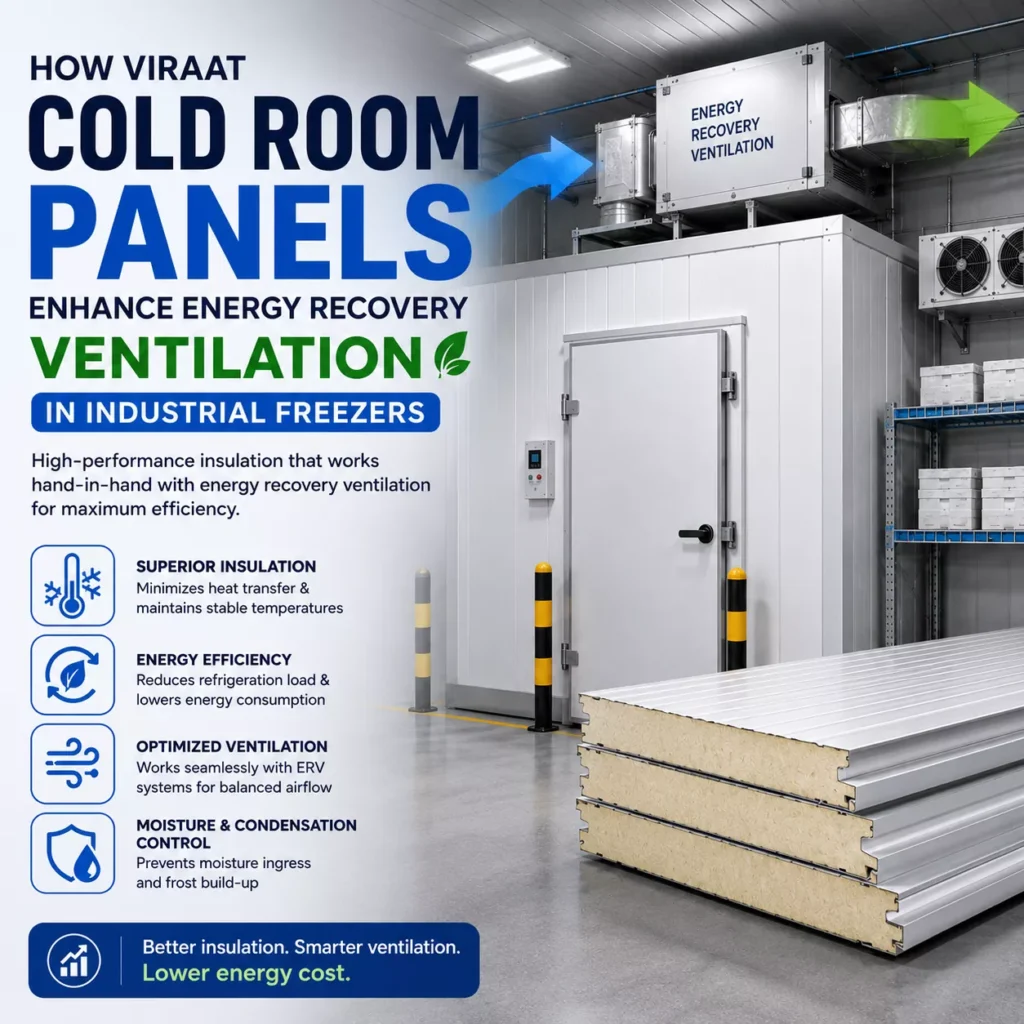
Industrial freezers operate continuously to maintain extremely low temperatures for food, pharmaceutical products, frozen goods, and other temperature-sensitive materials. Because these facilities require refrigeration around the clock, even small losses of conditioned air can increase energy consumption and operating costs.
An efficient building envelope is therefore essential for maintaining stable internal temperatures. Cold room panels for industrial freezers provide an insulated enclosure that minimizes unwanted heat transfer and helps refrigeration systems operate more efficiently. When combined with properly designed ventilation and energy recovery systems, high-performance insulated panels can contribute to a more energy-efficient and controlled freezer environment.
Viraat Industries manufactures insulated cold room panels designed to provide reliable thermal insulation, structural strength, and long-term performance for temperature-controlled applications.
What Are Cold Room Panels?
Cold room panels are insulated sandwich panels that help builders create walls, ceilings, and other sections of temperature-controlled facilities. They generally consist of an insulating core positioned between protective outer surfaces.
The insulation layer helps reduce heat transfer between the cold interior and the warmer external environment. This is particularly important in industrial freezers, where maintaining a consistent low temperature requires significant refrigeration capacity.
Viraat cold room panels are designed for applications where thermal insulation, hygiene, durability, and temperature control are important considerations.
Understanding Energy Recovery Ventilation in Industrial Freezers
Energy recovery ventilation, commonly known as ERV, is designed to reduce the energy required to condition incoming and outgoing air. Depending on the system design and operating environment, an energy recovery system can transfer thermal energy between exhaust air and incoming fresh air.
Industrial freezer environments present unique challenges because introducing warmer outside air can place an additional load on refrigeration equipment. Poorly controlled air exchange can result in heat gain, moisture infiltration, condensation, and increased refrigeration demand.
A well-designed insulated enclosure helps address part of this challenge by reducing uncontrolled heat transfer through walls and ceilings. This allows the ventilation and refrigeration systems to work within a more stable thermal environment.
How Viraat Cold Room Panels Support Energy Efficiency
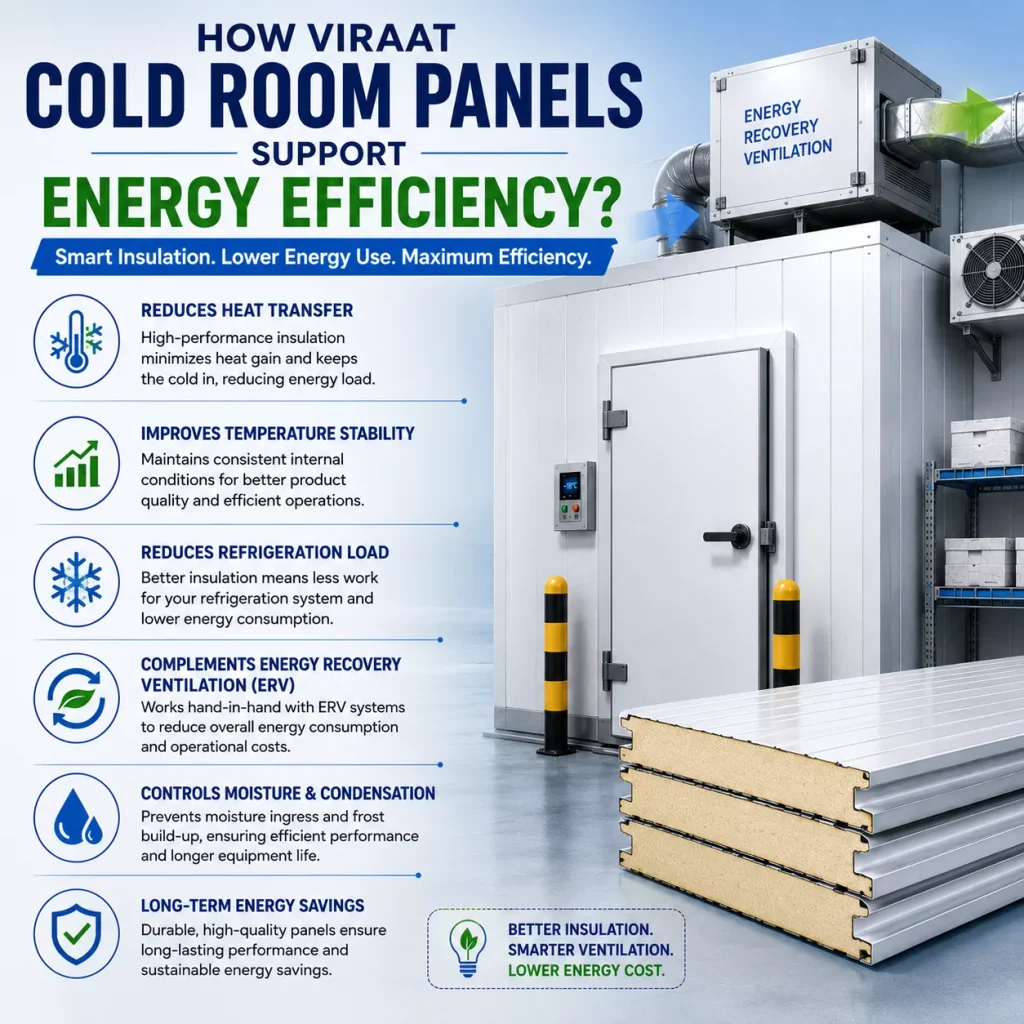
Reduce Heat Transfer
The primary function of an insulated cold room panel is to limit heat movement between the interior and exterior of the facility.
In an industrial freezer, the temperature difference between the cold interior and outside environment can be substantial. Without adequate insulation, heat can continuously enter the freezer, forcing refrigeration equipment to work harder.
Viraat cold room panels create an insulated barrier that helps reduce this heat transfer. Lower heat gain can help refrigeration equipment maintain the required temperature with less unnecessary workload.
Improve Temperature Stability
Temperature stability is critical in industrial freezing applications. Frequent temperature fluctuations can affect product quality and increase energy requirements.
Properly insulated walls and ceilings help maintain a more consistent internal environment. When ventilation systems introduce or remove air, the insulated enclosure helps minimize additional thermal losses through the building envelope.
This creates a more controlled environment where refrigeration and ventilation systems can operate more effectively.
Reduce Refrigeration Load
Refrigeration systems consume considerable energy in large industrial freezer facilities. Any unnecessary heat entering the freezer adds to the refrigeration load.
By limiting heat transfer through walls and ceilings, insulated cold room panels can reduce the amount of heat that refrigeration systems need to remove.
This can support better overall energy management, particularly in large-scale cold storage facilities operating continuously.
Complement Energy Recovery Ventilation
Energy recovery ventilation works by recovering usable thermal energy from air streams rather than allowing that energy to be completely lost.
However, ventilation is only one part of the overall energy-performance equation. The freezer envelope must also provide effective insulation.
Viraat cold room panels complement energy recovery strategies by helping minimize uncontrolled heat gain through the enclosure. When insulation and ventilation are properly integrated, the refrigeration system can operate in a more predictable environment.
Help Control Moisture and Condensation
Warm, humid air entering a cold environment can lead to condensation and, in some conditions, frost formation. This can affect surfaces, equipment, door areas, and overall freezer performance.
Properly constructed insulated panels, combined with appropriate joints, seals, doors, and ventilation design, can help reduce unwanted air infiltration.
Controlling moisture is particularly important in industrial freezers because excessive frost can reduce operational efficiency and increase maintenance requirements.
Importance of Panel Joints and Installation
The performance of a cold room is not determined by the insulation core alone. Panel joints, corners, doors, penetrations, ceiling connections, and other interfaces also influence the effectiveness of the enclosure.
Even high-quality insulation can perform poorly if panels are incorrectly installed or joints are not properly sealed.
For this reason, industrial freezer construction should consider:
- Proper panel alignment
- Secure panel connections
- Effective joint sealing
- Suitable doors and door seals
- Correct ceiling and wall integration
- Proper ventilation design
- Minimization of unnecessary air leakage
Professional installation helps ensure that the cold room envelope performs as intended.
Applications of Viraat Cold Room Panels
Viraat cold room panels can be considered for a wide range of temperature-controlled applications, including:
- Industrial freezers
- Cold storage warehouses
- Frozen food processing facilities
- Meat and seafood storage
- Dairy and food processing units
- Pharmaceutical storage facilities
- Distribution centers
- Temperature-controlled logistics facilities
- Ripening and controlled-temperature rooms
- Commercial and industrial cold rooms
The appropriate panel specification depends on the required operating temperature, room dimensions, environmental conditions, structural requirements, and project design.
Why Choose Viraat Cold Room Panels?
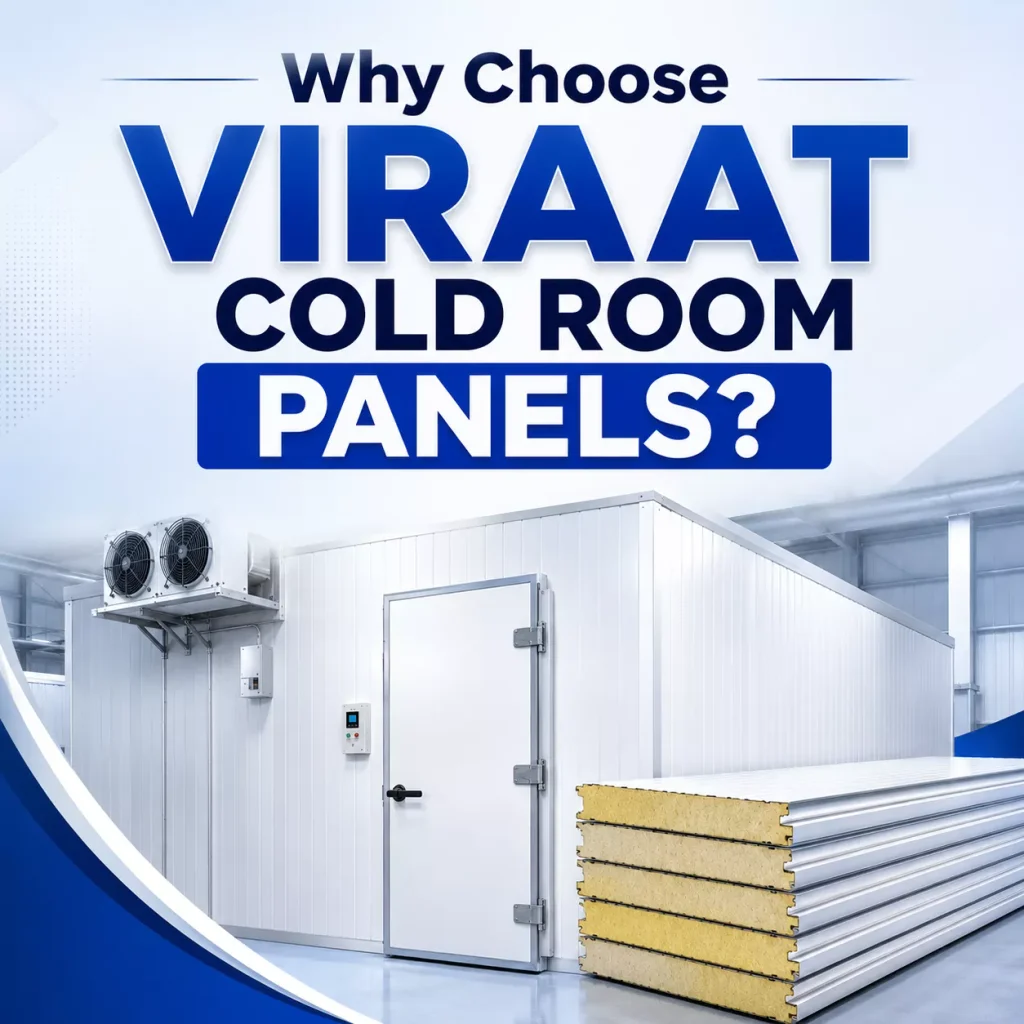
Viraat Industries focuses on insulated panel solutions for industrial and temperature-controlled applications. The right cold room panel can provide a combination of thermal insulation, durability, structural performance, and ease of installation.
Key advantages include:
Effective Thermal Insulation: Helps minimize unwanted heat transfer and supports stable internal temperatures.
Energy Efficiency: Reduced heat gain can help lower the refrigeration workload and contribute to efficient operation.
Temperature Control: Insulated walls and ceilings support consistent environmental conditions.
Durability: Robust panel construction is suitable for demanding industrial environments when properly specified and installed.
Hygienic Surfaces: Smooth panel surfaces can support easier cleaning and maintenance in food and temperature-sensitive facilities.
Flexible Applications: Panels can be used and incorporated into different cold storage, freezer, processing, and industrial environments.
Designing an Energy-Efficient Industrial Freezer
Choosing insulated panels should be part of a complete energy-efficiency strategy. Industrial freezer performance also depends on refrigeration equipment, ventilation, doors, air curtains, lighting, defrost systems, temperature controls, and operational practices.
An effective design should evaluate the entire system rather than focusing on one component.
For example, an energy-efficient freezer may combine high-performance insulated panels with appropriately sized refrigeration equipment and an energy recovery ventilation system. Properly sealed doors and controlled air exchange can further reduce unnecessary heat and moisture infiltration.
This integrated approach can help businesses improve temperature control while managing long-term energy consumption.
Maintenance for Long-Term Performance
Regular inspection is important for maintaining the performance of any industrial freezer enclosure. Facility operators should periodically check panel joints, seals, doors, surfaces, and areas around equipment penetrations.
Damaged panels or deteriorated seals should be addressed promptly. Regular maintenance can help prevent unnecessary air leakage and protect the overall thermal performance of the cold room.
Cleaning procedures should also be selected according to the panel surface and application requirements.
Conclusion
Energy efficiency in industrial freezers depends on the performance of the complete temperature-control system. While energy recovery ventilation can help optimize air exchange, an effective insulated building envelope is equally important.
Viraat cold room panels help create an insulated barrier that reduces heat transfer, supports temperature stability, and can complement energy-efficient ventilation and refrigeration strategies. By combining suitable cold room panels with proper installation, ventilation, refrigeration, sealing, and maintenance, industrial facilities can build a more controlled and efficient freezer environment.
For businesses planning a new industrial freezer, cold storage facility, or temperature-controlled processing area, selecting the right cold room panels for industrial freezers can be an important step toward achieving reliable thermal performance and long-term operational efficiency.
Frequently Asked Questions
What are cold room panels?
Cold room panels are insulated sandwich panels used to construct temperature-controlled rooms such as cold storage facilities, industrial freezers, and refrigeration rooms. They provide thermal insulation and help maintain a consistent internal temperature.
Why are cold room panels important for industrial freezers?
Cold room panels minimize heat transfer between the indoor and outdoor environments. This helps industrial freezers maintain the required low temperature while reducing the workload on refrigeration systems and improving energy efficiency.
Which insulation type do cold room panels commonly use?
PUF (Polyurethane Foam) works well in cold room panels because it offers low thermal conductivity and excellent insulation. PIR insulation also provides an effective option when a project requires enhanced thermal performance and greater fire resistance.
What thickness of cold room panel is suitable for industrial freezers?
The required panel thickness depends on the operating temperature, room size, application, and insulation requirements. Industrial freezer applications generally require thicker insulation than standard chilled rooms to minimize heat gain.
Can PUF Sandwich Panels Be Used for Industrial Freezer Rooms?
Yes. PUF sandwich panels work well in industrial freezer rooms, cold storage facilities, food processing units, warehouses, and other temperature-controlled spaces. Their excellent thermal insulation helps maintain the required temperature and supports energy-efficient cooling.
How do cold room panels improve energy efficiency?
High-quality insulated panels reduce heat infiltration into the cold room. As a result, the refrigeration system does not need to operate continuously at maximum capacity, which can help reduce energy consumption and operating costs.
Where are cold room panels used?
Industries use cold room panels in freezers, cold storage warehouses, food processing units, dairy facilities, pharmaceutical storage areas, meat and seafood plants, frozen food facilities, and temperature-controlled distribution centers.
Are cold room panels suitable for low-temperature applications?
Yes. Properly designed cold room panels can support low-temperature and frozen-storage applications. Choose the panel insulation type, thickness, joints, doors, flooring, and refrigeration system based on the required operating temperature.
What factors should you consider when selecting cold room panels?
Important factors include the required temperature range, panel thickness, insulation material, thermal conductivity, panel dimensions, joint design, surface material, hygiene requirements, fire-performance requirements, and the environmental conditions of the installation site.
How long do cold room panels last?
The service life of cold room panels depends on the quality of materials, installation, operating conditions, maintenance, and exposure to moisture or physical damage. Properly manufactured and installed panels can provide long-term performance in industrial applications.
Can manufacturers customize cold room panels?
Yes. Manufacturers can customize cold room panels according to project requirements, including panel thickness, dimensions, insulation specifications, surface finish, joint configuration, and application-specific needs.
How do installers install cold room panels?
Cold room panels are assembled using interlocking or specially designed joints to create an insulated enclosure. Proper installation is important because gaps, damaged joints, or inadequate sealing can result in air leakage and thermal losses.
What is the difference between cold room panels and regular sandwich panels?
Cold room panels provide thermal insulation and airtight construction for temperature-controlled environments. Manufacturers design regular sandwich panels mainly for general building insulation, so they may not meet the demanding requirements of low-temperature freezer applications.
Can cold room panels help reduce refrigeration costs?
Yes. Effective insulation reduces heat transfer into the cold room, allowing the refrigeration system to maintain the desired temperature more efficiently. This can contribute to lower energy consumption and operating costs.
How do I choose the right cold room panel manufacturer?
Choose a manufacturer with suitable manufacturing capabilities, quality insulation materials, customization options, technical expertise, and experience in cold storage and industrial applications. It is also important to consider panel specifications, installation support, and after-sales service.