























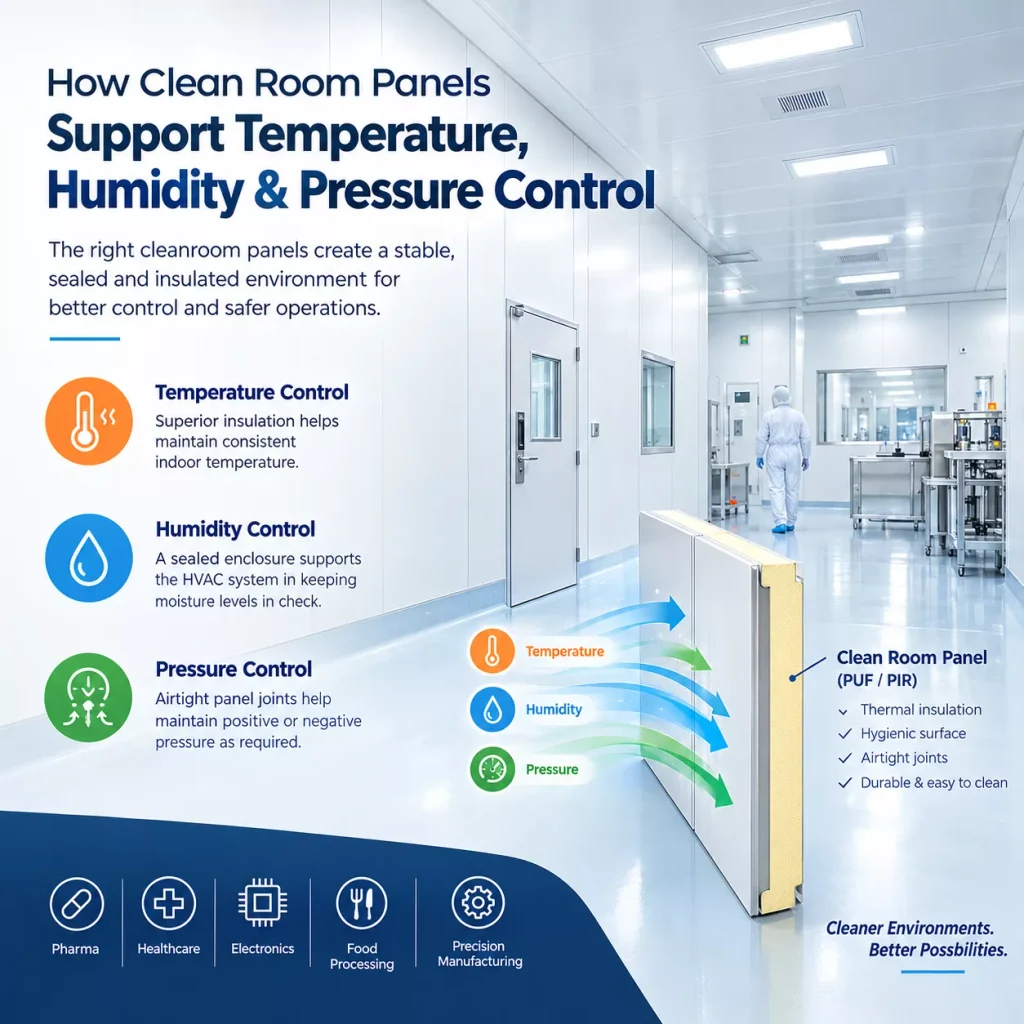
A cleanroom is designed to maintain a controlled environment where temperature, humidity, air pressure, and airborne contamination must remain within defined limits. Industries such as pharmaceuticals, healthcare, biotechnology, electronics, food processing, medical devices, and precision manufacturing depend on these controlled conditions to protect products and processes.
While HVAC and air-handling systems play a major role in maintaining the internal environment, the clean room panels used for walls and ceilings are equally important. A well-designed panel system creates an insulated and sealed enclosure that helps the HVAC system maintain the required conditions more consistently.
Cleanroom panels can support temperature stability, humidity management, pressure differentials, and contamination control when they are properly selected and installed.
What Are Clean Room Panels?
Clean room panels are specially designed wall and ceiling systems used to create controlled environments. Unlike conventional walls, these panels typically combine insulation with smooth, easy-to-clean surfaces and carefully designed joints.
Depending on the application, manufacturers can provide different panel constructions, thicknesses, surface finishes, and core materials. PUF and PIR clean room panels are commonly considered for applications where thermal insulation, hygiene, and controlled environmental conditions are important.
The panels form an enclosed environment around the cleanroom. This enclosure works together with HVAC equipment, air filtration, doors, lighting, and other cleanroom components to maintain the desired operating conditions.
1. How Clean Room Panels Support Temperature Control
Temperature stability is important in many controlled manufacturing environments. Excessive temperature variation can affect employee comfort, product quality, equipment performance, and certain manufacturing processes.
The insulation inside a cleanroom panel helps reduce heat transfer between the cleanroom and the surrounding environment.
For example, when the temperature outside the cleanroom rises significantly, a well-insulated panel system can reduce the rate at which external heat enters the room. Similarly, during cooler conditions, insulation can help limit heat loss.
This gives the HVAC system a more stable environment to manage.
Better Thermal Insulation
The insulation core acts as a barrier against unwanted heat movement. The performance of the overall system depends on factors such as:
- Panel core material
- Panel thickness
- Insulation properties
- Joint design
- Installation quality
- Door and window sealing
- Ceiling construction
Properly selected panels can therefore contribute to a more consistent internal temperature.
Reduced Temperature Fluctuations
Temperature control is not simply about reaching a particular temperature. Maintaining that temperature consistently is often more important.
Gaps, poorly sealed joints, and inadequate insulation can allow unwanted heat transfer and make the HVAC system work harder. A properly installed cleanroom panel system helps create a more stable enclosure.
2. The Role of Clean Room Panels in Humidity Control
Humidity control is another important requirement in many cleanroom applications.
Excessive moisture can create several problems. Depending on the industry and process, high humidity can contribute to condensation, material degradation, microbial growth, corrosion, and product-quality concerns.
Cleanroom panels do not independently remove moisture from the air. Instead, they help the HVAC and dehumidification system maintain the required humidity level by creating a properly insulated and sealed environment.
Preventing Unwanted Moisture Movement
A well-designed cleanroom enclosure limits uncontrolled air movement between the controlled space and surrounding areas.
When panel joints, doors, penetrations, and other interfaces are properly sealed, the HVAC system has better control over the air inside the room.
This is particularly useful in facilities where humidity needs to remain within a narrow operating range.
Reducing Condensation Risks
Temperature differences between indoor and outdoor surfaces can sometimes result in condensation if the construction is not properly designed.
Suitable insulation can help keep internal surfaces at more stable temperatures, reducing the likelihood of conditions that promote condensation.
However, the final humidity and condensation performance depends on the complete cleanroom design, including insulation, HVAC capacity, vapor control, room temperature, and external environmental conditions.
3. How Clean Room Panels Support Pressure Control
Pressure control is a key part of many cleanroom designs.
A cleanroom may operate at positive or negative pressure depending on the application.
Positive Pressure Cleanrooms
In a positive-pressure cleanroom, the pressure inside the room is maintained higher than the surrounding area.
When doors or other openings are closed, air tends to move outward rather than allowing uncontrolled air from less-clean areas to enter.
This approach is commonly used where protecting the product or process from external contamination is a priority.
Negative Pressure Cleanrooms
Negative-pressure environments maintain lower pressure inside the room compared with adjacent areas.
This configuration can be used when the primary objective is to prevent potentially contaminated air from escaping into surrounding spaces.
The exact pressure strategy depends on the application, room classification, airflow design, and regulatory requirements.
Why Panel Sealing Matters
HVAC equipment generates and controls the pressure difference, but the room enclosure must be sufficiently airtight for the system to work effectively.
Poorly sealed panel joints or unnecessary gaps can allow uncontrolled air leakage. This can make pressure control more difficult and increase the workload on air-handling equipment.
Cleanroom panels with properly designed joints and professional installation help create a more controlled enclosure.
4. Panel Joints Are Critical for Environmental Control
The performance of a cleanroom is not determined by the panel core alone.
Panel joints are equally important.
Even high-performance panels can lose some of their effectiveness if installation leaves gaps between panels or around doors, windows, service penetrations, and ceiling connections.
A well-executed cleanroom installation should focus on:
- Proper panel alignment
- Secure panel connections
- Sealed joints
- Correct corner detailing
- Proper door and window installation
- Sealing around service penetrations
- Suitable ceiling-to-wall connections
These details help minimize uncontrolled air movement and make cleaning and maintenance easier.
5. Clean Room Panels and HVAC Work Together
It is important to understand that clean room panels do not control temperature, humidity, or pressure by themselves.
The HVAC system performs the active control.
The panels create the controlled enclosure that allows the HVAC system to operate more effectively.
A typical cleanroom environment may involve:
Insulated panels → Airtight enclosure → HVAC system → Filtered airflow → Controlled temperature, humidity and pressure
If the enclosure has excessive air leakage or inadequate insulation, the HVAC system may need to compensate continuously.
Therefore, panel selection and HVAC design should be considered together rather than as completely separate components.
6. Why PUF and PIR Panels Make Ideal Choices for Cleanroom Applications
PUF and PIR panels provide effective thermal insulation while keeping the overall panel system lightweight, making them ideal for insulated environments.
PUF Clean Room Panels
Polyurethane foam provides thermal insulation and supports use in various controlled environments when the panel design meets the application’s requirements.
PIR Clean Room Panels
PIR, or polyisocyanurate, offers excellent insulation where thermal performance and fire resistance matter.
The appropriate panel type depends on the project requirements, including insulation needs, fire requirements, room conditions, surface finish, hygiene requirements, and applicable standards.
7. Applications Where Environmental Control Matters
Clean room panels can support controlled environments across several industries.
Pharmaceutical Manufacturing
Pharmaceutical facilities require controlled environments to protect processes and products from contamination and environmental variations.
Healthcare
Certain healthcare and medical environments require controlled temperature, humidity, pressure, and cleanliness.
Electronics Manufacturing
Electronic components can be sensitive to contamination, moisture, and environmental variations. Controlled rooms can help provide a more consistent manufacturing environment.
Food Processing
Hygienic environments are essential in food processing. Insulated cleanroom panels can support controlled temperature and humidity while providing smooth surfaces that are easier to clean.
Medical Device Manufacturing
Medical device production often requires controlled manufacturing conditions. Cleanroom panel systems can help create hygienic and manageable production areas.
Biotechnology and Research
Laboratories and biotechnology facilities may require carefully controlled environmental conditions depending on their processes.
8. Choosing the Right Clean Room Panel
Selecting a cleanroom panel should involve more than simply comparing panel prices.
Consider the following factors:
1. Insulation requirement:
Determine the required thermal performance based on the operating conditions.
2. Panel thickness:
Select an appropriate thickness based on the application’s thermal and structural requirements.
3. Core material:
PUF, PIR, and other options can be considered depending on the project.
4. Surface finish:
Smooth, durable, and easy-to-clean surfaces are important for hygienic environments.
5. Joint system:
A suitable joint design helps improve enclosure integrity and cleaning performance.
6. Fire performance:
Consider the applicable fire-safety requirements for the facility.
7. Installation quality:
Even high-quality panels can underperform if they are incorrectly installed.
8. Cleanroom requirements:
Panel selection should align with the required cleanroom classification, environmental conditions, airflow design, and applicable standards.
9. Why Proper Installation Matters
Installation quality has a direct impact on cleanroom performance.
Panel connections should be properly aligned and sealed. Open gaps, damaged surfaces, poorly installed doors, and unsealed service penetrations can compromise the enclosure.
Professional installation also helps maintain the intended appearance, hygiene, durability, and environmental performance of the cleanroom.
For this reason, panel selection and installation should be treated as part of the overall cleanroom engineering process.
Conclusion
Clean room panels play an important supporting role in temperature, humidity, and pressure control. They provide the insulated and enclosed environment that allows HVAC and air-management systems to maintain controlled conditions more efficiently.
From pharmaceutical production and medical devices to electronics, biotechnology, and food processing, the right cleanroom enclosure can contribute to a stable, hygienic, and manageable working environment.
However, successful environmental control depends on the complete system. Panel insulation, joint design, installation quality, HVAC capacity, filtration, doors, ceilings, and service penetrations all need to work together.
For facilities planning a new cleanroom or upgrading an existing one, choosing appropriately designed PUF or PIR clean room panels and installing them correctly can be an important step toward achieving reliable environmental control.