























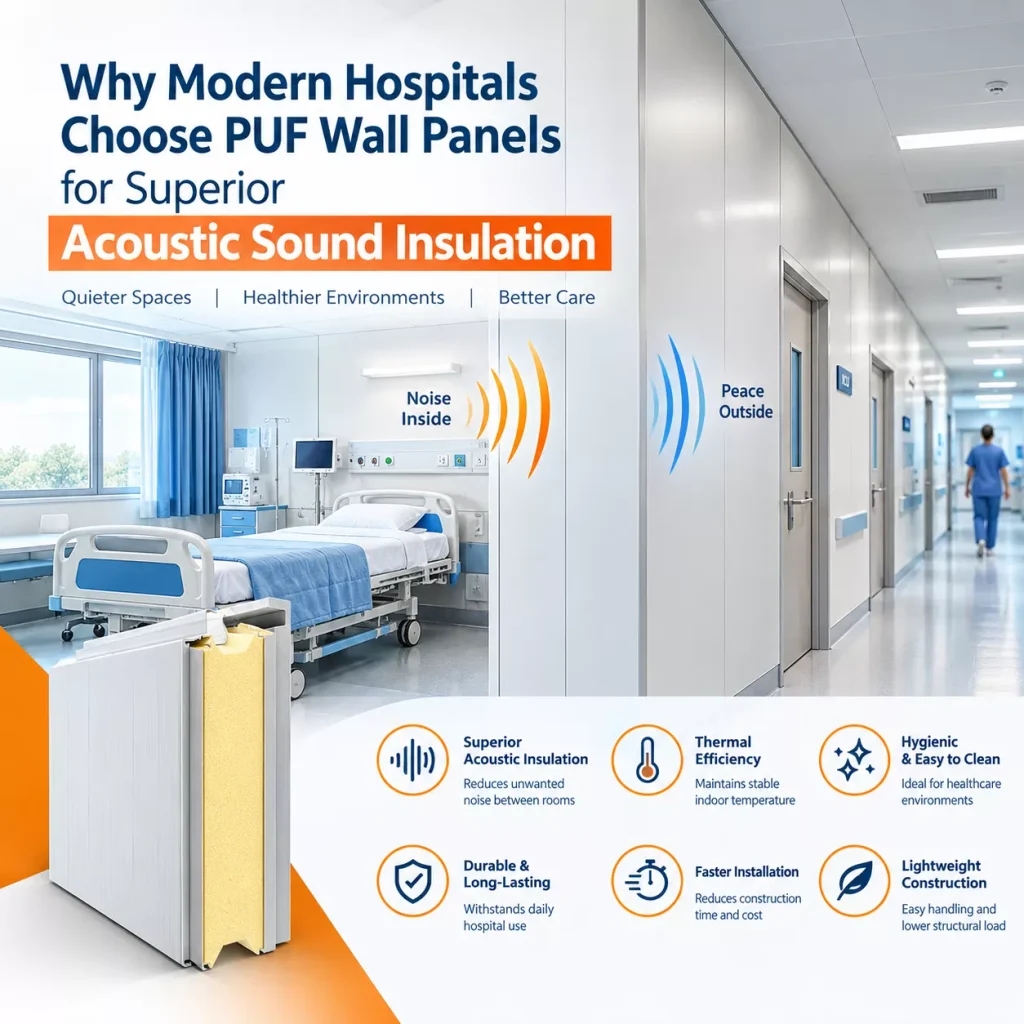
Hospitals require carefully controlled indoor environments where patient comfort, staff concentration, hygiene, temperature stability, and privacy all matter. Among the many building materials available today, PUF wall panels for hospitals are becoming an increasingly practical solution for healthcare facilities that need efficient wall systems with insulation and acoustic performance.
Hospital buildings are exposed to a wide range of sounds, including conversations, medical equipment, alarms, footsteps, trolley movement, doors, HVAC systems, and activity in corridors. Excessive noise can make healthcare environments stressful for patients and can also affect concentration among doctors, nurses, and other healthcare professionals. This makes acoustic planning an important part of modern hospital construction.
PUF, or polyurethane foam, wall panels combine an insulated core with protective outer surfaces to create lightweight wall systems suitable for various controlled indoor environments. Depending on the panel design, thickness, joints, surrounding construction, and installation quality, these panels can contribute to improved sound control while also providing thermal insulation and a cleanable wall surface.
Understanding Acoustic Insulation in Hospitals
Acoustic insulation refers to the ability of a building system to reduce the transmission of unwanted sound between spaces. In a hospital, sound control can be important in areas such as patient rooms, intensive care areas, consultation rooms, laboratories, treatment rooms, recovery areas, and staff spaces.
A wall system does not work independently. Overall acoustic performance depends on several factors, including wall construction, panel thickness, density, joints, doors, ceilings, floors, penetrations, and mechanical services. Therefore, selecting an insulated panel should be considered as part of the hospital’s complete acoustic design.
PUF wall panels for hospitals can help create more controlled indoor spaces by providing an insulated barrier between rooms. Their lightweight construction and tightly joined panel system can also help reduce unwanted sound pathways when properly designed and installed.
Why Hospitals Need Better Sound Control
A hospital is naturally an active environment. Ambulance movements, patient transfers, medical equipment, staff communication, cleaning activities, and visitor traffic can generate considerable noise throughout the day and night.
For patients, continuous noise can make rest and recovery more difficult. In consultation rooms and examination areas, appropriate acoustic separation can support greater privacy. In staff areas, controlling unnecessary background noise can create a more comfortable working environment.
The objective is not necessarily to make every hospital room completely silent. Instead, the goal is to manage sound transmission and create spaces appropriate for their intended use.
This is one reason modern healthcare projects increasingly consider insulated wall systems rather than relying only on conventional masonry partitions.
How PUF Wall Panels Support Acoustic Performance
The polyurethane foam core in a PUF panel creates an insulated layer within the wall assembly. This construction can help reduce the direct transmission of sound compared with some lightweight, uninsulated wall arrangements.
The acoustic performance of a PUF wall panel depends on its complete assembly rather than the core material alone. Panel thickness, surface material, joint design, installation method, supporting structure, and openings can all influence the final result.
When panels are installed correctly with properly sealed joints and compatible accessories, they can create a continuous wall surface with fewer potential gaps.
For hospitals, this combination of insulation, panel continuity, and practical installation can be particularly useful where controlled environments are required.
Thermal Insulation Is Another Major Advantage
Acoustic performance is only one reason hospitals consider PUF wall systems. Healthcare buildings also require effective temperature management.
PUF has low thermal conductivity, allowing the insulated panel core to reduce heat transfer through the wall. This can support more stable indoor temperatures and reduce the workload placed on air-conditioning systems.
Stable temperatures are particularly important in healthcare facilities where different rooms may have specific environmental requirements. When used as part of an appropriately designed building envelope, insulated panels can contribute to energy efficiency and occupant comfort.
This dual function—thermal insulation along with sound-control benefits—makes PUF panels attractive for modern construction.
Hygienic Wall Surfaces for Healthcare Environments
Hygiene is one of the most important considerations in hospitals. Wall surfaces should be designed to support regular cleaning and maintenance while minimizing areas where dirt and contaminants can accumulate.
PUF wall panels are available with smooth protective surface finishes that can be easier to clean than rough or highly textured wall surfaces. Properly designed panel joints and accessories can also help create a more controlled wall system.
For sensitive healthcare environments, however, material selection should always consider the specific cleaning chemicals, hygiene requirements, surface finish, joint details, and applicable project standards.
This makes PUF panels particularly useful for applications where cleanliness and controlled indoor conditions are priorities.
Suitable Applications of PUF Wall Panels in Hospitals
The versatility of insulated panels allows them to be considered for several hospital applications.
Patient Rooms
Patient rooms need a comfortable environment where rest and privacy are important. Properly designed insulated wall systems can help reduce sound transmission while also supporting indoor temperature control.
Consultation Rooms
Doctors and patients often discuss confidential information during consultations. Appropriate wall construction can contribute to acoustic privacy between adjacent rooms.
Laboratories
Laboratories may require controlled environmental conditions, easy-to-maintain surfaces, and temperature stability. PUF panels can be incorporated into suitable laboratory wall systems depending on project specifications.
Intensive Care Areas
ICUs contain numerous medical devices and require continuous staff activity. Acoustic planning can help create a more controlled environment for patients and healthcare professionals.
Clean Rooms
Hospitals may require specialized clean rooms for medical procedures, pharmaceutical applications, research, and other controlled processes. PUF panels can be used in clean-room wall and ceiling systems when the selected panel construction meets the required specifications.
Isolation Areas
Isolation rooms require carefully planned building systems. Insulated panels can be incorporated into walls where controlled environments, cleanable surfaces, and appropriate thermal conditions are required.
Faster Installation Compared with Conventional Construction
Hospital projects often operate under demanding schedules. Delays in construction can affect project costs and the planned opening of medical facilities.
PUF sandwich wall panels are manufactured as prefabricated building components. Their factory-produced dimensions can help streamline installation at the construction site.
Instead of building and curing conventional masonry walls layer by layer, installers can position the panels, secure them to the supporting structure, and complete the required joints and accessories.
The exact installation time depends on the project size, wall configuration, supporting structure, workforce, and finishing requirements. Nevertheless, prefabricated insulated panels can help reduce construction complexity and support faster project execution.
Lightweight Construction
Another advantage of PUF panels is their relatively lightweight construction compared with many conventional wall systems.
Reduced wall weight can be beneficial in projects where structural loading, material handling, and installation logistics need to be carefully managed. Panels can also be transported and positioned more efficiently when the project is properly planned.
For hospitals undergoing expansion or renovation, lightweight partition systems can offer practical advantages, although structural and fire-safety requirements must always be evaluated by qualified professionals.
Durable and Low-Maintenance Wall Systems
Hospitals experience continuous daily use. Walls can be exposed to cleaning, movement of equipment, trolley traffic, humidity, and general wear.
A properly selected PUF panel with an appropriate surface finish can provide a durable wall solution for demanding indoor applications. The performance of the finished wall depends on the quality of the panel, surface coating, joint treatment, installation, and maintenance.
Selecting the right panel specification is therefore essential. Hospitals should consider the intended environment, expected exposure, cleaning requirements, fire-performance requirements, and applicable building standards before installation.
Fire Safety Must Remain a Priority
Although PUF panels provide several useful properties, healthcare facilities require particularly careful attention to fire safety.
Not all insulated panels have the same fire performance. Panel core, thickness, facing material, joint construction, supporting structure, and installation details can influence fire behaviour.
Hospitals should therefore select panels based on the applicable fire-safety requirements and project specifications rather than choosing a product solely for its acoustic or thermal insulation.
Where higher fire resistance is required, the project team may evaluate alternative insulated cores or specialized fire-rated wall systems.
Choosing the Right PUF Wall Panel for a Hospital
Before selecting PUF wall panels for hospitals, project teams should evaluate several factors:
- Required acoustic performance
- Panel thickness and insulation requirements
- Surface finish and cleanability
- Joint and sealing system
- Fire-performance requirements
- Moisture and environmental exposure
- Room temperature requirements
- Cleaning and maintenance procedures
- Door, window, and service penetrations
- Applicable healthcare and building standards
- Installation quality and workmanship
Acoustic performance should ideally be verified using appropriate test data for the complete wall assembly rather than relying only on the insulation-core specification.
Why PUF Wall Panels Are Becoming Popular in Modern Healthcare Construction
Modern hospitals are moving toward construction systems that combine performance, hygiene, efficiency, durability, and speed. PUF wall panels fit this requirement because a single prefabricated system can provide thermal insulation while supporting acoustic control and cleanable wall construction.
Their factory-manufactured nature can also simplify installation and help maintain consistency across large projects. This makes them suitable for hospitals, laboratories, clinics, diagnostic centres, clean rooms, and other healthcare facilities where controlled indoor conditions are important.
However, choosing the right panel is only one part of the solution. Proper detailing, installation, sealing, doors, ceilings, floors, and mechanical services must all be considered to achieve the desired acoustic environment.
Conclusion
PUF wall panels for hospitals offer a practical combination of insulation, cleanable surfaces, lightweight construction, durability, and installation efficiency. Their insulated core can contribute to better sound and temperature control when incorporated into a properly designed wall assembly.
For modern hospitals, where patient comfort, privacy, staff productivity, hygiene, and energy efficiency are all important, insulated panel systems can provide a versatile alternative to conventional wall construction.
Before selecting a PUF panel, healthcare project teams should evaluate acoustic requirements alongside fire safety, hygiene, thermal performance, structural considerations, and applicable standards. With the right specification and professional installation, PUF wall panels can become an effective component of a high-performance hospital building envelope.