























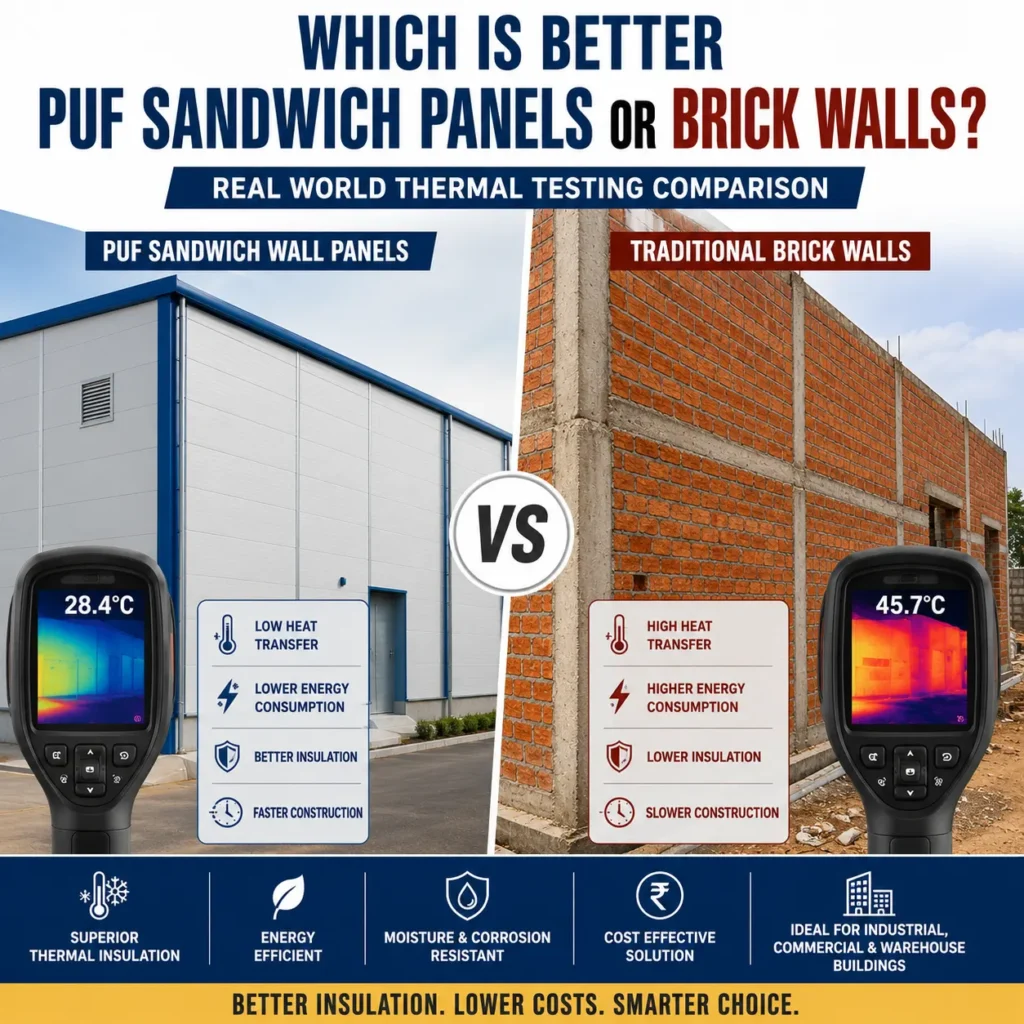
When planning an industrial building, warehouse, cold storage unit, commercial facility, or even a modern residential structure, one important question always arises: Which Is Better PUF Sandwich Panels or Brick Walls?
The answer depends on several factors such as thermal insulation, energy efficiency, construction speed, durability, and long-term maintenance costs. Traditional brick walls have been used for centuries, but modern construction technologies like PUF sandwich wall panels are rapidly becoming the preferred choice for energy-efficient buildings.
In this blog, we will explore the results of real-world thermal testing and compare PUF sandwich wall panels against traditional brick walls to understand which option performs better under practical conditions.
Understanding PUF Sandwich Wall Panels
PUF (Polyurethane Foam) sandwich wall panels are advanced insulated panels made with a rigid polyurethane foam core placed between two metal sheets. These panels are widely used in:
- Industrial buildings
- Cold storage facilities
- Clean rooms
- Warehouses
- Portable cabins
- Commercial spaces
- Food processing units
The major advantage of PUF sandwich panels is their exceptional thermal insulation capability. The foam core minimizes heat transfer, helping maintain stable indoor temperatures.
What Are Traditional Brick Walls?
Traditional brick walls are constructed using clay bricks and cement mortar. Brick walls have long been considered durable and strong, especially for residential and commercial construction.
However, while brick walls provide structural stability, they are not naturally optimized for thermal insulation. In hot climates, brick walls absorb and retain heat, increasing indoor temperatures and energy consumption.
Real World Thermal Testing: PUF Panels vs Brick Walls
To determine which is better PUF sandwich panels or brick walls, thermal performance testing was conducted under real-world environmental conditions.
Testing Conditions
The thermal comparison involved two identical rooms:
- One room is constructed with traditional brick walls
- Another room constructed using PUF sandwich wall panels
Both structures were exposed to similar weather conditions, including direct sunlight and fluctuating outdoor temperatures.
The testing focused on:
- Heat transfer rate
- Indoor temperature stability
- Energy consumption
- Cooling efficiency
- Overall thermal performance
Thermal Insulation Performance
One of the biggest differences observed during the testing was thermal insulation efficiency.
PUF Sandwich Wall Panels
PUF sandwich wall panels significantly reduced heat transfer from the external environment. The polyurethane foam core acted as an effective thermal barrier, helping maintain cooler indoor temperatures even during peak daytime heat.
Benefits observed:
- Reduced indoor heat gain
- Better temperature consistency
- Lower cooling load on air conditioning systems
- Faster cooling retention
Traditional Brick Walls
Brick walls absorbed heat throughout the day and gradually released it indoors. This process increased indoor temperatures, especially during the afternoon and evening hours.
Challenges observed:
- Higher heat absorption
- Increased indoor temperature fluctuations
- Greater dependence on cooling systems
- Slow thermal response
The testing clearly showed that PUF sandwich wall panels performed better in thermal insulation compared to brick walls.
Energy Efficiency Comparison
Energy efficiency is a major concern for industrial and commercial building owners. Poor insulation leads to excessive electricity consumption and higher operating costs.
Performance of PUF Panels
Buildings made with PUF sandwich wall panels required less energy for cooling because the insulated panels minimized external heat penetration.
Key observations included:
- Reduced air conditioning usage
- Lower electricity bills
- Faster temperature stabilization
- Improved HVAC efficiency
Performance of Brick Walls
Brick wall structures required continuous cooling to maintain comfortable indoor temperatures. The absorbed heat increased HVAC workload, leading to higher energy consumption.
As a result, the thermal testing confirmed that PUF sandwich wall panels provide superior energy efficiency compared to traditional brick walls.
Construction Speed and Installation
Another important factor when evaluating which is better PUF sandwich panels or brick walls is construction time.
PUF Sandwich Wall Panels
PUF panels are prefabricated and ready for installation. This enables faster project completion and reduced labor requirements.
Advantages include:
- Quick installation
- Reduced construction time
- Minimal site mess
- Lower labor costs
Brick Walls
Brick wall construction is labor-intensive and time-consuming. It requires masonry work, curing time, plastering, and finishing processes.
This often results in:
- Longer project timelines
- Increased labor dependency
- Higher construction costs
- Delayed occupancy
For projects requiring rapid construction, PUF sandwich wall panels offer a major advantage.
Moisture Resistance and Weather Protection
Environmental conditions play a crucial role in wall performance.
PUF Panels
PUF sandwich panels provide excellent resistance against moisture and external weather conditions. The metal surfaces and insulated core help prevent water seepage and thermal leakage.
Brick Walls
Traditional brick walls may develop cracks and moisture absorption over time, especially in humid environments. Water seepage can reduce wall durability and insulation performance.
In industrial applications, PUF panels provide better long-term protection against environmental damage.
Space Utilization Benefits
PUF sandwich wall panels are thinner than conventional brick walls while still offering superior insulation.
This provides:
- More usable interior space
- Better design flexibility
- Lightweight construction benefits
Brick walls generally require greater thickness to achieve similar insulation levels, reducing available usable space.
Maintenance and Long-Term Performance
PUF sandwich wall panels require relatively low maintenance when properly installed. Their corrosion-resistant surfaces and insulation properties remain effective for years.
Brick walls, on the other hand, may require:
- Repainting
- Crack repairs
- Waterproofing treatments
- Structural maintenance over time
This makes PUF panels a cost-effective long-term solution for modern infrastructure projects.
Which Is Better PUF Sandwich Panels or Brick Walls?
Based on real-world thermal testing and practical construction analysis, PUF sandwich wall panels outperform traditional brick walls in several critical areas, including:
- Thermal insulation
- Energy efficiency
- Faster construction
- Lightweight performance
- Moisture resistance
- Reduced maintenance
- Lower operational costs
While brick walls still offer traditional appeal and structural familiarity, modern industries and commercial projects increasingly prefer PUF sandwich panels for their superior thermal and energy-saving capabilities.
Why Choose Viraat Industries for PUF Sandwich Wall Panels?
Viraat Industries is a trusted manufacturer of high-quality PUF sandwich wall panels designed for industrial, commercial, and specialized construction applications.
Viraat Industries focuses on:
- Advanced insulation technology
- Durable and high-performance panels
- Precision manufacturing
- Custom panel solutions
- Energy-efficient building systems
Whether you are constructing a warehouse, cold storage facility, factory, modular structure, or commercial building, Viraat Industries provides reliable PUF sandwich panel solutions that improve thermal performance and reduce energy costs.
Conclusion
The debate around which is better PUF sandwich panels or brick walls becomes clearer when real-world thermal testing is considered. PUF sandwich wall panels deliver better insulation, improved energy efficiency, faster installation, and lower maintenance compared to traditional brick walls.
As industries continue to prioritize sustainable and cost-effective construction methods, PUF sandwich wall panels are emerging as the smarter and more future-ready solution.
For businesses looking to improve building performance while reducing operational expenses, investing in high-quality PUF sandwich wall panels from Viraat Industries is a practical and efficient choice.
Frequently Asked Questions
PUF sandwich panels are generally considered better for modern industrial, commercial, and prefabricated construction due to their superior thermal insulation, faster installation, and energy efficiency. Traditional brick walls remain popular for conventional masonry construction.
Yes. PUF sandwich panels contain a polyurethane foam core that significantly reduces heat transfer, helping maintain stable indoor temperatures compared to traditional brick walls.
PUF sandwich panels are more energy efficient because they minimize heat gain and reduce the workload on air-conditioning and cooling systems, resulting in lower electricity consumption.
While initial costs may vary by project, PUF panels often reduce overall construction expenses through faster installation, lower labor costs, and long-term energy savings.
For many industrial, commercial, cold storage, clean room, and prefab construction projects, PUF sandwich panels can effectively replace traditional brick walls while providing additional insulation and energy-saving benefits.