























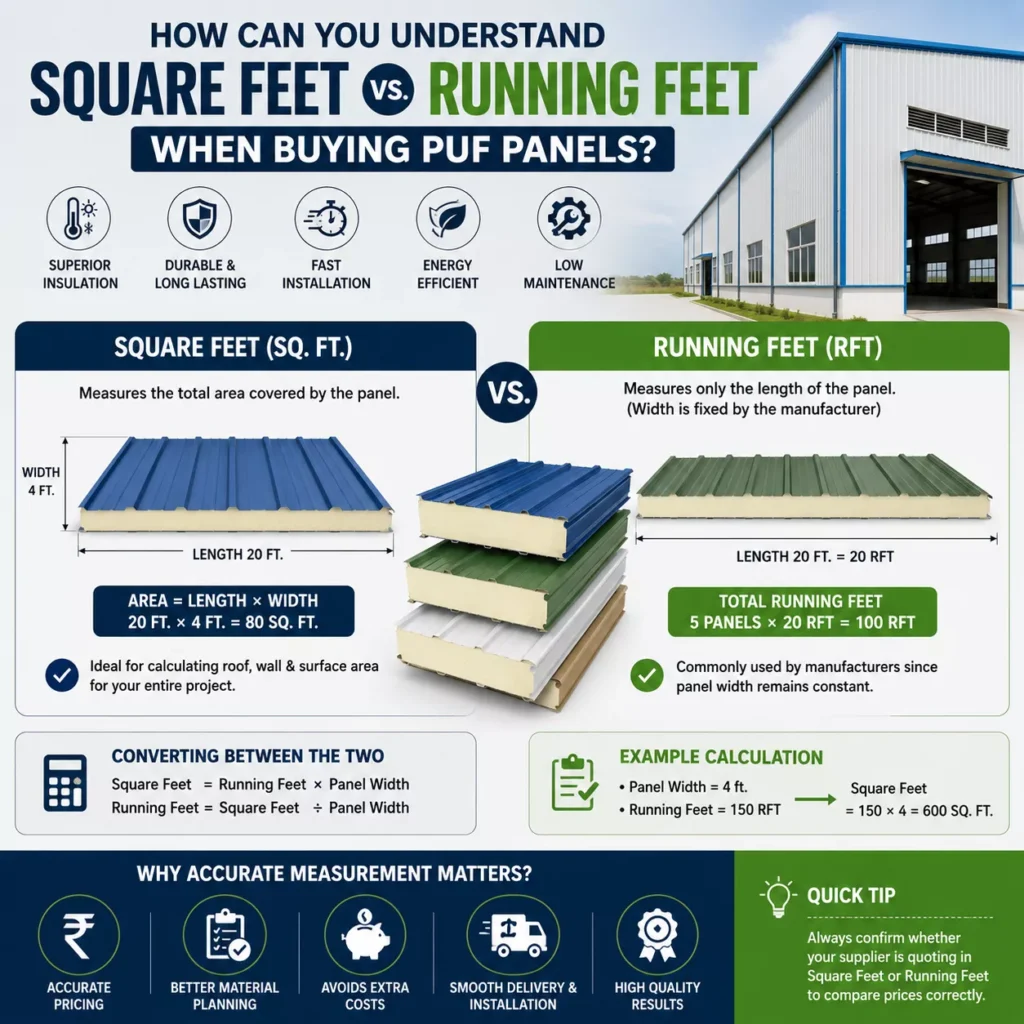
When planning a construction project using PUF panels, one of the most common questions buyers ask is whether the panels are priced in square feet or running feet. Understanding these two measurement methods is essential because they directly impact your project budget, material estimation, and purchasing decisions.
Many first-time buyers become confused when different suppliers provide quotations using different units. While one manufacturer may quote the price per square foot, another may mention the cost per running foot. Without understanding the difference, comparing quotations becomes difficult and may even lead to inaccurate budgeting.
This guide explains the difference between square feet vs running feet PUF panel pricing, how each measurement works, and how you can calculate the actual cost for your construction project.
Understanding PUF Panels
PUF (Polyurethane Foam) panels are insulated sandwich panels consisting of a rigid polyurethane foam core bonded between two metal sheets. These panels provide excellent thermal insulation, structural strength, and long service life.
They are widely used in:
- Cold rooms
- Clean rooms
- Warehouses
- Industrial buildings
- Prefabricated offices
- Residential rooms
- Poultry farms
- Food processing units
- Pharmaceutical facilities
- Commercial buildings
Because PUF panels are manufactured in different thicknesses, widths, and lengths, understanding their pricing measurements becomes very important before placing an order.
What Is Square Feet Measurement?
Square feet (sq. ft.) is the measurement of area. It calculates how much surface a panel covers.
The formula is simple:
Area = Length × Width
For example, if a PUF panel measures:
- Length = 20 feet
- Width = 4 feet
The total area becomes:
20 × 4 = 80 square feet
Roofing and wall calculations for construction projects are generally performed in square feet because the overall building area is measured by surface coverage.
Many manufacturers provide quotations based on the total square feet required for the project.
What Is Running Feet Measurement?
Running feet (RFT) measures only the length of the panel.
Unlike square feet, the panel width remains fixed and is not included in the calculation because manufacturers already know the standard effective panel width.
For example, if a panel has:
- Width = 4 feet (standard)
- Length = 20 feet
The running feet measurement is simply:
20 Running Feet
If you purchase five panels of the same size:
5 × 20 = 100 Running Feet
This pricing method is commonly used because manufacturers produce panels in standard widths.
Why Do Some Manufacturers Quote Running Feet?

Many PUF panel manufacturers prefer running feet because their production lines manufacture panels with fixed widths.
The only variable is the panel length.
For example:
Standard Width = 1 meter (approximately 3.28 ft)
or
Standard Width = 4 feet
Since the width never changes, pricing only by running feet simplifies manufacturing, production planning, transportation, and billing.
Why Others Use Square Feet Pricing
Contractors, architects, consultants, and project owners usually estimate materials based on building area.
They naturally calculate:
- Roof area
- Wall area
- Partition area
Since these dimensions are expressed in square feet, many suppliers also provide quotations in square feet for easier comparison with construction drawings.
This method is especially common in turnkey construction projects.
Converting Running Feet to Square Feet
Fortunately, converting between these two measurements is straightforward when you know the panel width.
Square Feet = Running Feet × Panel Width
For example:
Running Feet = 150
Panel Width = 4 feet
Area =
150 × 4
= 600 Square Feet
Similarly,
Running Feet = 250
Panel Width = 3.28 feet
Area =
250 × 3.28
= 820 Square Feet
Knowing the panel width allows you to compare quotations accurately.
Converting Square Feet to Running Feet
If your supplier quotes in running feet while your project drawings show square feet, simply reverse the calculation.
Running Feet = Square Feet ÷ Panel Width
Example:
Roof Area = 1,200 sq. ft.
Panel Width = 4 ft.
Running Feet =
1,200 ÷ 4
= 300 Running Feet
This calculation helps determine the number of panels required.
Which Pricing Method Is Better?
Neither pricing method is better than the other.
They simply represent different ways of expressing the same material quantity.
Square Feet Pricing is ideal for:
- Contractors
- Architects
- Consultants
- Building owners
- Cost estimation
Running Feet Pricing is ideal for:
- Manufacturers
- Factory production
- Transportation planning
- Inventory management
As long as you know the panel width, both pricing methods lead to the same total material quantity.
Factors That Influence PUF Panel Pricing
Whether pricing is given in square feet or running feet, several factors determine the final cost.
Panel Thickness
Thicker insulation requires more polyurethane foam, increasing manufacturing costs.
Common thicknesses include:
- 30 mm
- 40 mm
- 50 mm
- 60 mm
- 80 mm
- 100 mm
- 120 mm
- 150 mm
Greater thickness usually means better insulation but a higher price.
Metal Sheet Thickness
The outer steel sheets are available in various gauges.
Thicker metal provides greater strength and durability but also increases cost.
Coating Type
Panels may be manufactured using:
- Pre-painted galvanized steel
- Galvalume steel
- Stainless steel
- Aluminum
Each material has different pricing based on corrosion resistance and application.
Panel Length
Longer panels require careful transportation and handling.
Very long panels may involve additional logistics costs.
Quantity Ordered
Bulk orders often receive lower per-unit pricing because manufacturing becomes more efficient.
Accessories
Complete installation may require:
- Flashings
- Fasteners
- Sealants
- Joint profiles
- Corner trims
These additional components contribute to the overall project cost.
Common Mistakes Buyers Should Avoid
Many buyers compare quotations without checking the pricing unit.
Some common mistakes include:
- Comparing running feet with square feet directly.
- Ignoring the effective panel width.
- Forgetting to include installation accessories.
- Overlooking transportation charges.
- Not confirming panel thickness.
- Comparing panels with different metal sheet specifications.
Always request complete technical specifications before making a purchasing decision.
Tips for Accurate Cost Estimation
To estimate your project correctly:
- Measure the total roof and wall area accurately.
- Confirm the effective panel width with the manufacturer.
- Check whether the quotation is in square feet or running feet.
- Verify panel thickness and metal specifications.
- Include accessories and installation costs.
- Allow extra material for cutting and wastage.
- Compare quotations based on identical specifications.
These steps help avoid unexpected expenses during installation.
Benefits of Understanding Pricing Measurements

Knowing the difference between square feet and running feet offers several advantages:
- Easier comparison between suppliers
- Accurate budgeting
- Better material planning
- Reduced risk of ordering errors
- Improved communication with manufacturers
- Faster project estimation
- Greater confidence during purchasing
This knowledge ensures you receive exactly the quantity required without overspending.
Choosing the Right PUF Panel Supplier
Beyond pricing, selecting a reliable manufacturer is equally important. Look for suppliers who offer:
- High-density insulation cores
- Quality-tested raw materials
- Accurate panel dimensions
- Consistent manufacturing standards
- Technical support
- On-time delivery
- Custom panel lengths
- Warranty and after-sales service
A trusted manufacturer will provide transparent pricing and help you understand every aspect of your quotation.
Conclusion
Understanding square feet vs running feet PUF panel pricing is essential for anyone planning a construction project. While square feet measures the total surface area and running feet measures only the panel length, both methods are valid and widely used in the PUF panel industry. The key is knowing the panel’s effective width so you can convert between the two measurements accurately.
By understanding these pricing methods, comparing supplier quotations becomes much easier, helping you estimate costs correctly and avoid confusion during procurement. Whether you are constructing a warehouse, cold room, prefabricated office, industrial building, or residential space, knowing how PUF panels are measured will ensure smarter purchasing decisions, better budget management, and a more efficient project execution.
Frequently Asked Questions
Square feet (sq. ft.) measure the total surface area covered by a PUF panel, while running feet (RFT) measure only the panel’s length. Square feet are commonly used for pricing roofing and wall panels because they reflect the actual area covered.
Most PUF panel manufacturers quote prices based on square feet or square meters, although some projects may use running feet depending on the panel profile and width. Always confirm the unit of measurement before placing an order.
Knowing the difference helps buyers estimate material requirements accurately, compare supplier quotations fairly, avoid over-ordering, and control project costs.
To calculate the area:
Square Feet = Running Feet × Panel Width (in feet)
For example, if a panel is 3.5 feet wide and 20 running feet long, the total coverage is 70 square feet.
Yes. Some manufacturers quote prices in square feet, while others use square meters. Ensure you know which unit is being used before comparing quotations.
No. Always compare the complete specifications, including insulation thickness, foam density, steel quality, coating, warranty, and manufacturing standards, instead of price alone.