























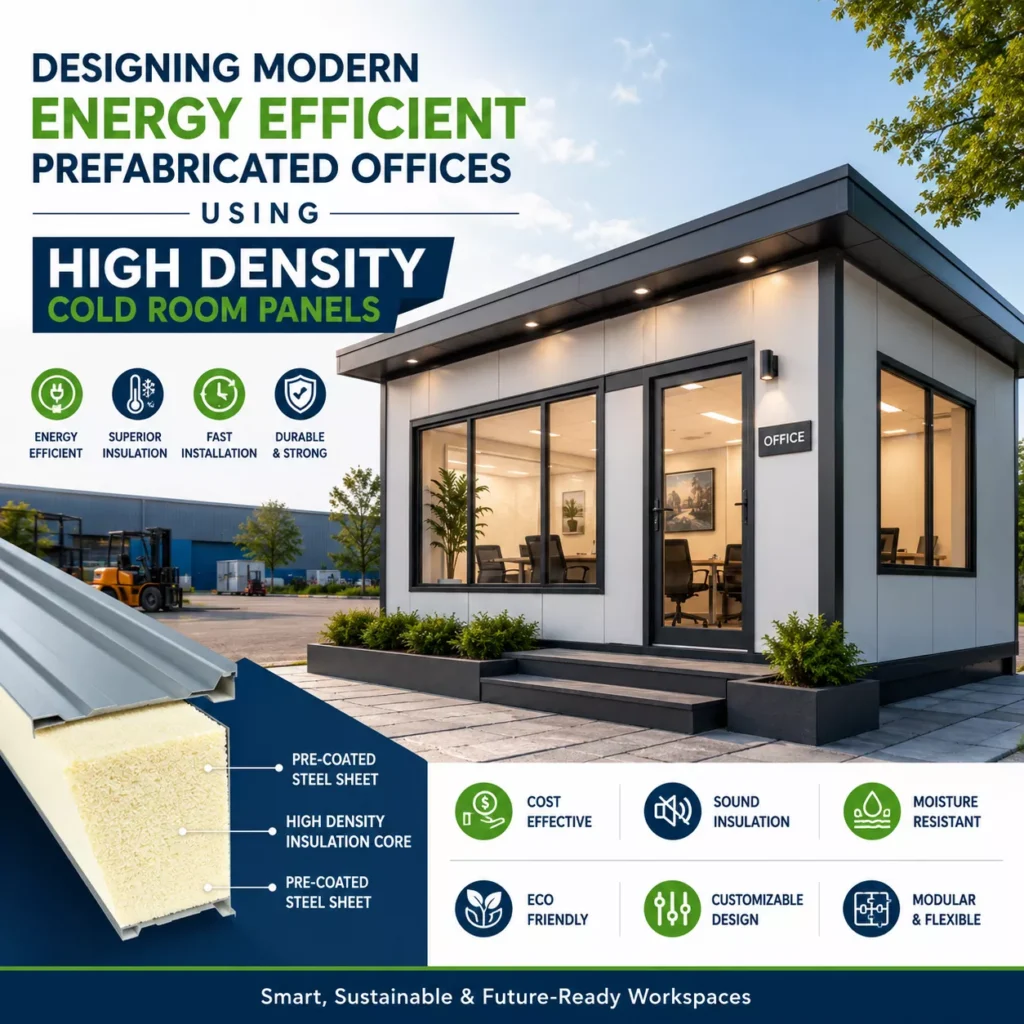
In today’s rapidly evolving business environment, companies are increasingly looking for office solutions that combine speed, sustainability, durability, and energy efficiency. Traditional construction methods often involve lengthy timelines, higher labor costs, and significant energy consumption. As a result, modern energy-efficient prefabricated offices have emerged as a preferred alternative for industrial facilities, construction sites, commercial establishments, educational institutions, and temporary workspace requirements.
One of the most effective materials used in the construction of these advanced office spaces is the high-density cold room panel. Originally developed for temperature-controlled environments, these insulated panels have proven highly beneficial in prefabricated office construction due to their exceptional thermal insulation, structural strength, and long-term performance.
This article explores the benefits, applications, design considerations, and advantages of using high-density cold room panels for creating modern energy-efficient prefabricated offices.
What Are High Density Cold Room Panels?
High-density cold room panels are insulated sandwich panels consisting of a rigid polyurethane foam (PUF) or polyisocyanurate (PIR) core enclosed between durable metal sheets. These panels are engineered to provide excellent thermal insulation and structural integrity.
The high-density insulation core minimizes heat transfer, making these panels ideal for applications requiring temperature control and energy conservation. Their superior insulating properties also make them highly suitable for prefabricated office buildings where indoor comfort and reduced energy consumption are essential.
Why Prefabricated Offices Are Gaining Popularity
Businesses today require flexible and scalable workspace solutions. Prefabricated offices offer numerous advantages over conventional construction, including:
- Faster project completion
- Reduced construction waste
- Lower labor costs
- Enhanced energy efficiency
- Easy relocation and expansion
- Minimal site disruption
- Improved sustainability
By integrating high-density cold room panels into the design, organizations can further enhance the performance and comfort of prefabricated office spaces.
Benefits of High Density Cold Room Panels in Prefabricated Offices
Superior Thermal Insulation
One of the primary advantages of high-density cold room panels is their exceptional thermal insulation capability. The insulated core significantly reduces heat transfer between the interior and exterior environments.
This helps maintain comfortable indoor temperatures throughout the year while reducing dependence on air conditioning and heating systems. Consequently, businesses experience lower energy consumption and reduced operational costs.
Enhanced Energy Efficiency
Energy efficiency has become a major priority for organizations seeking sustainable building solutions. Prefabricated offices constructed with high-density insulated panels help maintain stable indoor temperatures, reducing energy usage and carbon emissions.
The thermal barrier created by the insulation core ensures that cooled or heated air remains inside the building, improving overall HVAC performance and minimizing energy losses.
Faster Construction and Installation
Traditional office construction can take several months to complete. In contrast, prefabricated offices using insulated panels can be assembled in a fraction of the time.
Since the panels are manufactured in controlled factory environments, installation on-site becomes quick and efficient. This significantly reduces project timelines and allows businesses to occupy their new office spaces sooner.
Lightweight Yet Structurally Strong
Despite their lightweight nature, high-density cold room panels provide excellent structural strength. This combination enables easier transportation, handling, and installation while maintaining durability and reliability.
The reduced structural load also lowers foundation requirements, contributing to overall project cost savings.
Improved Indoor Comfort
A comfortable work environment directly impacts employee productivity and satisfaction. High-density insulated panels help maintain consistent indoor temperatures and minimize external heat infiltration.
Employees benefit from a more comfortable workspace, resulting in enhanced concentration, efficiency, and overall well-being.
Sound Insulation Properties
Noise pollution can negatively affect workplace productivity. High-density cold room panels offer excellent acoustic insulation, reducing external noise and creating a quieter office environment.
This feature is particularly beneficial for offices located near manufacturing plants, highways, airports, or busy commercial zones.
Moisture and Condensation Resistance
Moisture buildup can lead to mold growth, structural damage, and unhealthy indoor conditions. High-quality insulated panels are designed to resist moisture penetration and condensation formation.
This helps preserve the structural integrity of the office while maintaining a healthy and hygienic indoor environment.
Long-Term Durability
Prefabricated offices are expected to provide reliable performance for many years. High-density cold room panels are manufactured using corrosion-resistant metal facings and durable insulation cores that withstand challenging environmental conditions.
Their resistance to weather, moisture, and temperature fluctuations ensures long-lasting performance with minimal maintenance requirements.
Key Design Considerations for Energy Efficient Prefabricated Offices
Panel Thickness Selection
Choosing the appropriate panel thickness is critical for achieving optimal thermal performance. The required thickness depends on factors such as:
- Climate conditions
- Building location
- Energy efficiency goals
- Internal temperature requirements
Thicker insulated panels generally provide higher thermal resistance and improved energy savings.
Efficient Building Layout
A well-planned office layout contributes significantly to energy efficiency. Designers should consider:
- Natural daylight utilization
- Proper ventilation systems
- Strategic workspace placement
- Efficient HVAC integration
Combining these elements with insulated panels creates a highly efficient office environment.
Window and Door Integration
Energy-efficient windows and insulated doors complement the thermal performance of high-density cold room panels.
Proper sealing around openings helps eliminate air leakage and further enhances energy conservation.
Ventilation Systems
Modern prefabricated offices require effective ventilation to maintain indoor air quality. Energy-efficient ventilation systems help regulate fresh air circulation while minimizing energy losses.
When integrated with insulated panel construction, ventilation systems create a healthier and more comfortable workspace.
Sustainable Building Practices
Organizations increasingly prioritize environmentally responsible construction methods. High-density insulated panels support sustainability goals through:
- Reduced energy consumption
- Lower carbon emissions
- Minimal construction waste
- Recyclable metal components
- Extended building lifespan
These benefits contribute to greener and more environmentally friendly office developments.
Applications of Prefabricated Offices Using High Density Cold Room Panels
The versatility of insulated panel construction makes it suitable for a wide range of applications.
Industrial Office Buildings
Manufacturing facilities often require administrative offices located close to production areas. High-density insulated panels provide comfortable office environments while protecting occupants from external heat and noise.
Construction Site Offices
Temporary site offices demand rapid installation and mobility. Prefabricated offices built with insulated panels offer quick deployment and easy relocation as project requirements change.
Corporate Extensions
Growing businesses can expand their office space efficiently using prefabricated modular office solutions. The scalable nature of insulated panel systems allows future modifications and extensions with minimal disruption.
Educational Facilities
Schools, training centers, and educational institutions utilize prefabricated office structures for administrative spaces, faculty offices, and temporary classroom facilities.
Remote Work Locations
Mining sites, infrastructure projects, and remote industrial operations benefit from energy-efficient prefabricated offices that provide comfortable working conditions in challenging environments.
Cost Savings and Return on Investment
Although insulated panel construction may involve an initial investment, the long-term savings are substantial. Benefits include:
- Lower energy bills
- Reduced maintenance costs
- Faster occupancy
- Extended building lifespan
- Improved operational efficiency
These factors contribute to an attractive return on investment for businesses seeking cost-effective office infrastructure solutions.
The Future of Prefabricated Office Construction
As businesses continue to prioritize sustainability, flexibility, and operational efficiency, prefabricated offices constructed with high-density cold room panels are expected to play an increasingly important role in modern building design.
Advancements in insulation technology, modular construction methods, and energy-efficient building systems are making these office solutions more attractive than ever. Their ability to deliver comfort, durability, and environmental performance aligns perfectly with the evolving needs of modern organizations.
Conclusion
Modern energy-efficient prefabricated offices using high-density cold room panels represent a smart and sustainable solution for today’s businesses. Their exceptional thermal insulation, rapid installation, durability, and energy-saving capabilities make them an ideal choice for a wide range of commercial and industrial applications.
By incorporating high-density insulated panels into prefabricated office design, organizations can create comfortable, cost-effective, and environmentally responsible workspaces that support productivity while reducing long-term operational expenses. As the demand for efficient building solutions continues to grow, insulated panel-based prefabricated offices will remain at the forefront of modern construction innovation.
Frequently Asked Questions
Prefabricated offices are modular structures built using insulated cold room panels with a high-density PUF or PIR core. These panels provide excellent thermal insulation, durability, and quick installation, making them ideal for modern office spaces.
High-density cold room panels offer superior thermal performance, structural strength, and energy efficiency. They help maintain comfortable indoor temperatures while reducing air-conditioning costs.
Yes. Prefabricated offices are widely used in factories, warehouses, construction sites, logistics hubs, corporate campuses, and industrial facilities due to their flexibility and quick installation.
The insulated PUF/PIR core minimizes heat transfer, helping maintain stable indoor temperatures and reducing the load on HVAC systems, which lowers energy consumption.
Yes. High-density insulated panels help maintain comfortable indoor temperatures in hot summers, cold winters, and humid environments, making them suitable for diverse climatic conditions.
Viraat Industries manufactures high-quality insulated PUF and PIR panels using advanced continuous production technology. Their panels provide superior insulation, structural reliability, fast installation, and long-term performance for modern prefabricated office projects.