























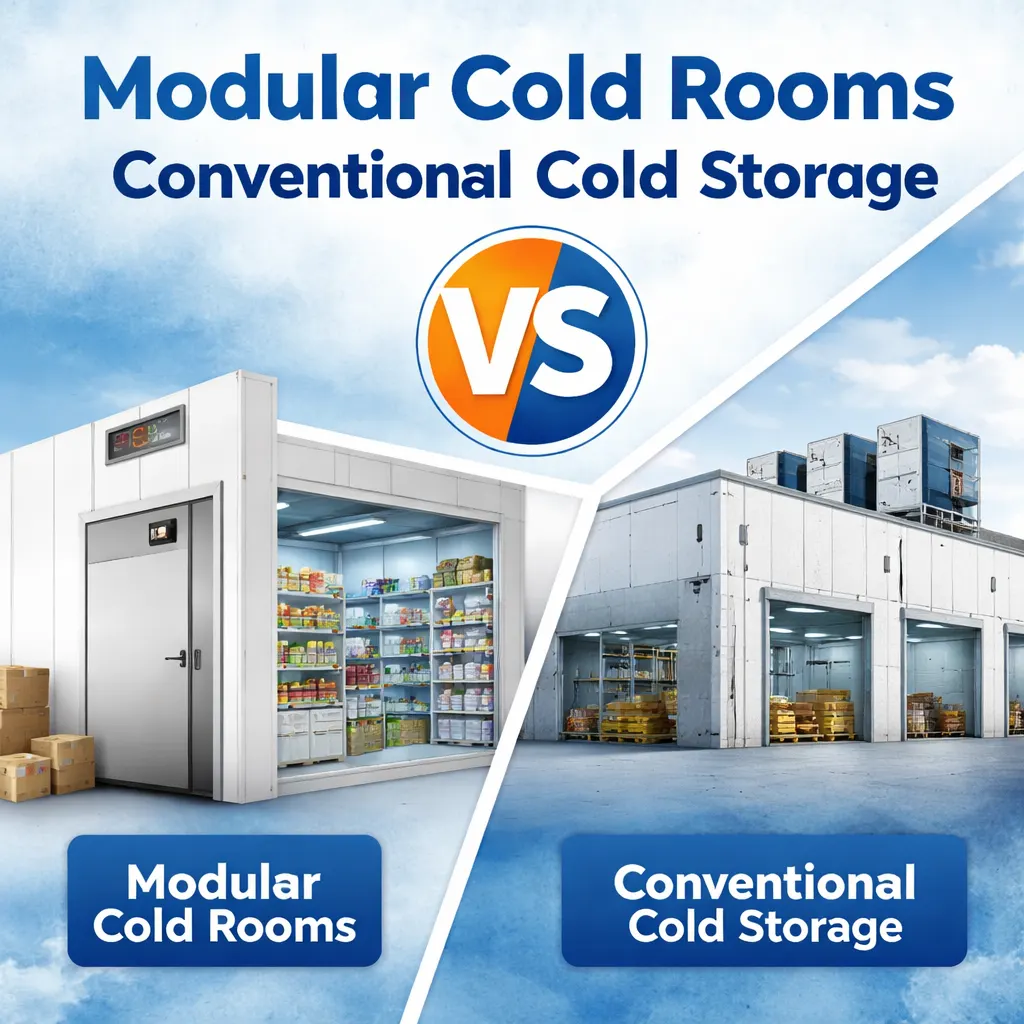
Cold storage plays a crucial role in industries such as food processing, pharmaceuticals, agriculture, hospitality, and logistics. Choosing the right type of cold storage solution directly impacts product quality, energy efficiency, scalability, and operational costs. Two popular options available today are modular cold rooms and conventional cold storage systems. While both serve the same purpose of temperature-controlled storage, they differ significantly in design, installation, cost, flexibility, and long-term usability.
This article explores the key differences between modular cold rooms and conventional cold storage to help businesses make an informed decision.
Definition and Structure
Modular cold rooms are prefabricated cold storage units made from insulated panels that are manufactured in standard sizes. These panels are assembled on-site, making the system highly adaptable and easy to install. Modular cold rooms are designed to be scalable, allowing users to expand or relocate them when business needs change.
Conventional cold storage, on the other hand, is typically a permanent structure built using traditional construction materials like bricks, concrete, and custom insulation. These facilities are designed specifically for a fixed location and purpose, often requiring extensive civil work and longer construction timelines.
Installation Time and Complexity
One of the most significant differences between modular cold rooms and conventional cold storage is installation time.
Modular cold rooms are quick to install because the components are pre-engineered and factory-finished. Depending on the size, installation can be completed in a few days. Minimal civil work is required, reducing labor costs and downtime.
Conventional cold storage requires detailed planning, structural construction, insulation layering, and integration of the refrigeration system. Installation can take several weeks or even months, making it less suitable for businesses that need rapid deployment.
Cost Considerations
Cost is a deciding factor for many businesses.
Modular cold rooms panels generally have a lower initial investment compared to conventional cold storage. Since they require less construction work and manpower, upfront costs are more predictable. Additionally, maintenance and repair costs are usually lower because individual panels or components can be replaced easily.
Conventional cold storage involves higher capital expenditure due to construction, specialized insulation, and permanent infrastructure. While it may offer long-term benefits for large-scale operations, the initial cost can be a barrier for small and medium-sized businesses.
Flexibility and Scalability
Flexibility is where modular cold rooms clearly outperform conventional cold storage.
Modular cold rooms are designed for easy expansion. Businesses can add or remove panels to increase or decrease storage capacity. They can also be dismantled and relocated if operations shift to a new site.
Conventional cold storage lacks this adaptability. Once built, modifications are expensive and complex. Relocation is nearly impossible, making it suitable only for businesses with stable, long-term storage requirements.
Energy Efficiency
Energy efficiency is critical for reducing operational costs.
Modular cold rooms panels use high-quality insulated panels, often with polyurethane foam, which minimizes thermal loss. Their airtight construction ensures efficient temperature control, leading to lower energy consumption when properly designed.
Conventional cold storage can also be energy-efficient, but performance depends heavily on construction quality and insulation standards. Poor insulation or aging structures may lead to higher energy losses over time, increasing electricity costs.
Maintenance and Repairs
Maintenance requirements differ significantly between the two systems.
Modular cold rooms are easier to maintain because individual components can be accessed and replaced without disrupting the entire structure. This reduces downtime and repair costs.
Conventional cold storage often requires extensive maintenance work. Repairs to insulation or structural components may involve partial demolition, making maintenance more time-consuming and expensive.
Applications and Use Cases
Modular cold rooms are ideal for:
- Restaurants and hotels
- Supermarkets and food retailers
- Pharmaceutical storage
- Cloud kitchens and food processing units
- Temporary or seasonal storage needs
Conventional cold storage is better suited for:
- Large-scale warehouses
- Long-term bulk storage
- Export and import hubs
- Industrial food processing plants
Customization Options
Both systems offer customization, but in different ways.
Modular cold rooms allow customization in terms of size, temperature range, shelving, and door types. However, they follow standardized panel dimensions.
Conventional cold storage offers complete design freedom, making it suitable for highly specific storage requirements. This customization comes at a higher cost and longer execution time.
Conclusion
When comparing modular cold rooms vs conventional cold storage, the right choice depends on business size, budget, scalability needs, and time constraints. Modular cold rooms are cost-effective, flexible, quick to install, and ideal for growing or dynamic businesses. Conventional cold storage, while more expensive and time-consuming to build, is suitable for large-scale, permanent operations requiring long-term storage stability.
By understanding these differences, businesses can select a cold storage solution that aligns with their operational goals, budget, and future growth plans — ensuring efficiency, reliability, and optimal product preservation.
Frequently Asked Questions
A cold room is a specifically designed refrigerated chamber (often built with modular insulated panels) used to maintain a consistently low temperature for storing perishable items such as food, pharmaceuticals, and other temperature-sensitive products.
Cold rooms are typically smaller to medium in capacity, suitable for individual businesses or localized storage, whereas conventional cold storage facilities are large-scale warehouses designed to store bulk volumes of perishable goods for extended durations.
No — cold rooms usually use modular insulated panels that allow quicker and more flexible installation, while conventional cold storage facilities rely on more robust civil construction, structural steel, and advanced insulation systems.
Yes — while cold rooms usually maintain a single temperature range, larger cold storage facilities are often designed with multiple temperature zones or chambers for handling different types of products within the same warehouse.
Yes — cold rooms generally consume less energy due to their smaller size and simpler cooling systems, whereas conventional cold storage facilities require more powerful refrigeration systems and often higher overall energy to maintain consistent large-volume cooling.
Conventional cold storage is more suitable for industrial cold chains and export logistics, as it supports large volumes, complex airflow systems, and often integrates automation and monitoring for global supply demands.
Modular cold rooms can be reconfigured or relocated more easily due to their panel-based construction. In contrast, conventional cold storage buildings are typically fixed, permanent structures that aren’t designed for relocation.